

Key Findings
-
Consumer AI adoption hardly grew even as spending tripled. The share of U.S. adults using AI rose just three points, from 61% to 64%, while global consumer spend reached an estimated $40 billion in 2026, more than 3x last year. The real growth came from existing users going deeper and paying more: 55% of AI users now pay for at least one AI product, and 46% of payers spend more than they did a year ago, versus 12% who spend less.
-
Power users are driving consumer AI market growth: 55% of AI users now pay for AI, but spending is highly concentrated; the top 14% of payers account for 60% of spending. Payers are also nearly twice as likely to use AI daily (50% vs. 26%) and 5x as likely to use AI agents (65% vs. 13%).
-
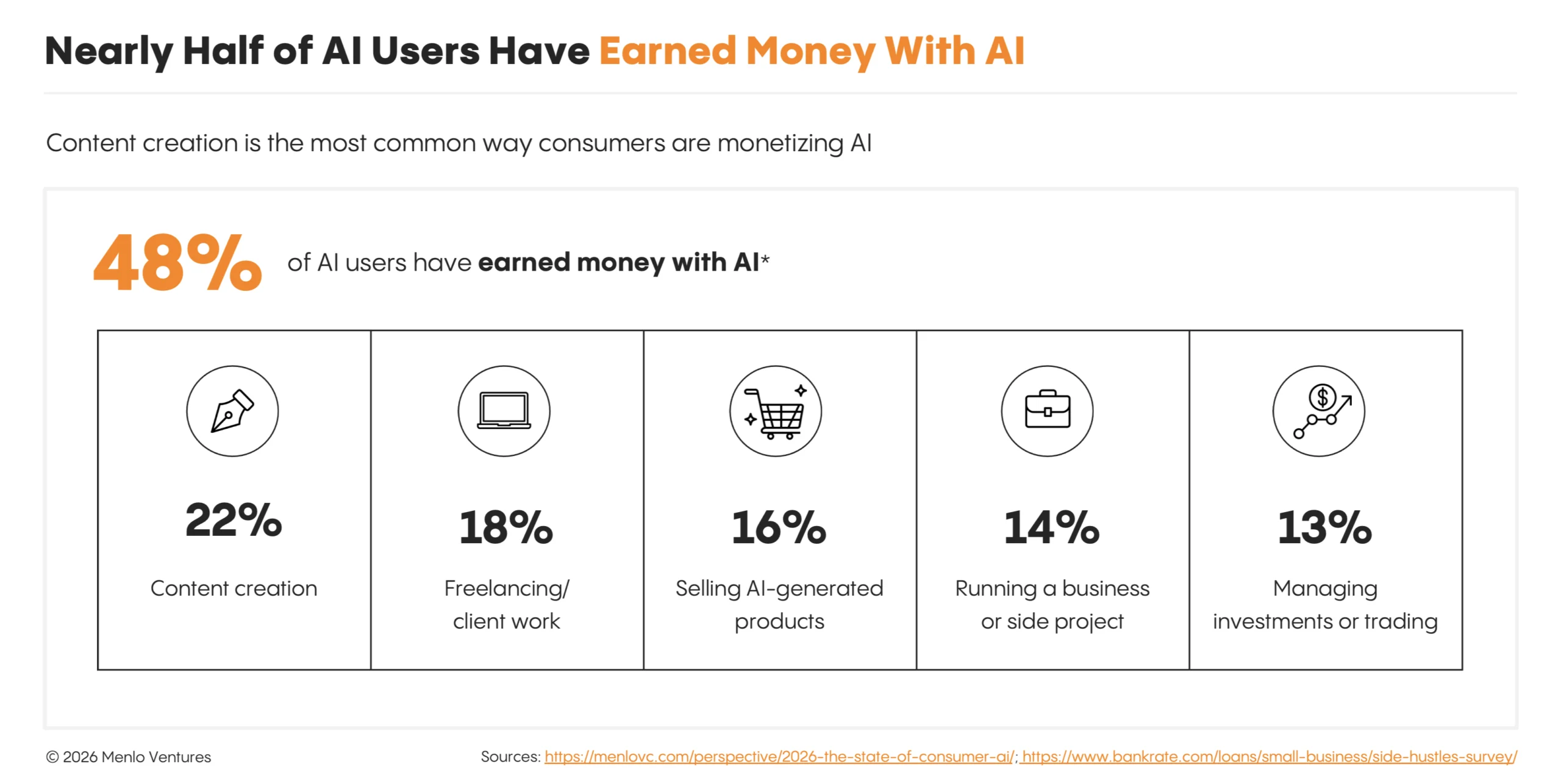
AI is becoming a source of income: Nearly half (48%) of AI users have earned money with AI, equivalent to roughly 30% of Americans.
-
Consumers are handing AI more control: 41% of AI users have tried an AI agent, 24% use one regularly, and 32% have let AI act on their behalf without final approval. Among agent users, 92% pay for AI, and 63% use it daily.
-
AI-generated content is fueling consumer backlash: AI is fueling a creative boom, but 36% of consumers say they are less likely to engage with content if they know it was AI-generated, compared to just 14% who would be more interested.
-
Trust is becoming the gatekeeper for consumer AI: AI users now rank accuracy (45%), trustworthiness (40%), and security and privacy (36%) ahead of ease of use, which fell from 38% to 32%. Among AI holdouts (non-users), 70% distrust the information AI provides, up from 58%, 76% cite privacy, and 83% would rather deal with a person.
Consumer AI Adoption Hardly Grew in 2026, But Spend Tripled
Last year, consumer AI broke into the mainstream. This year, adoption barely moved—even as spending exploded.
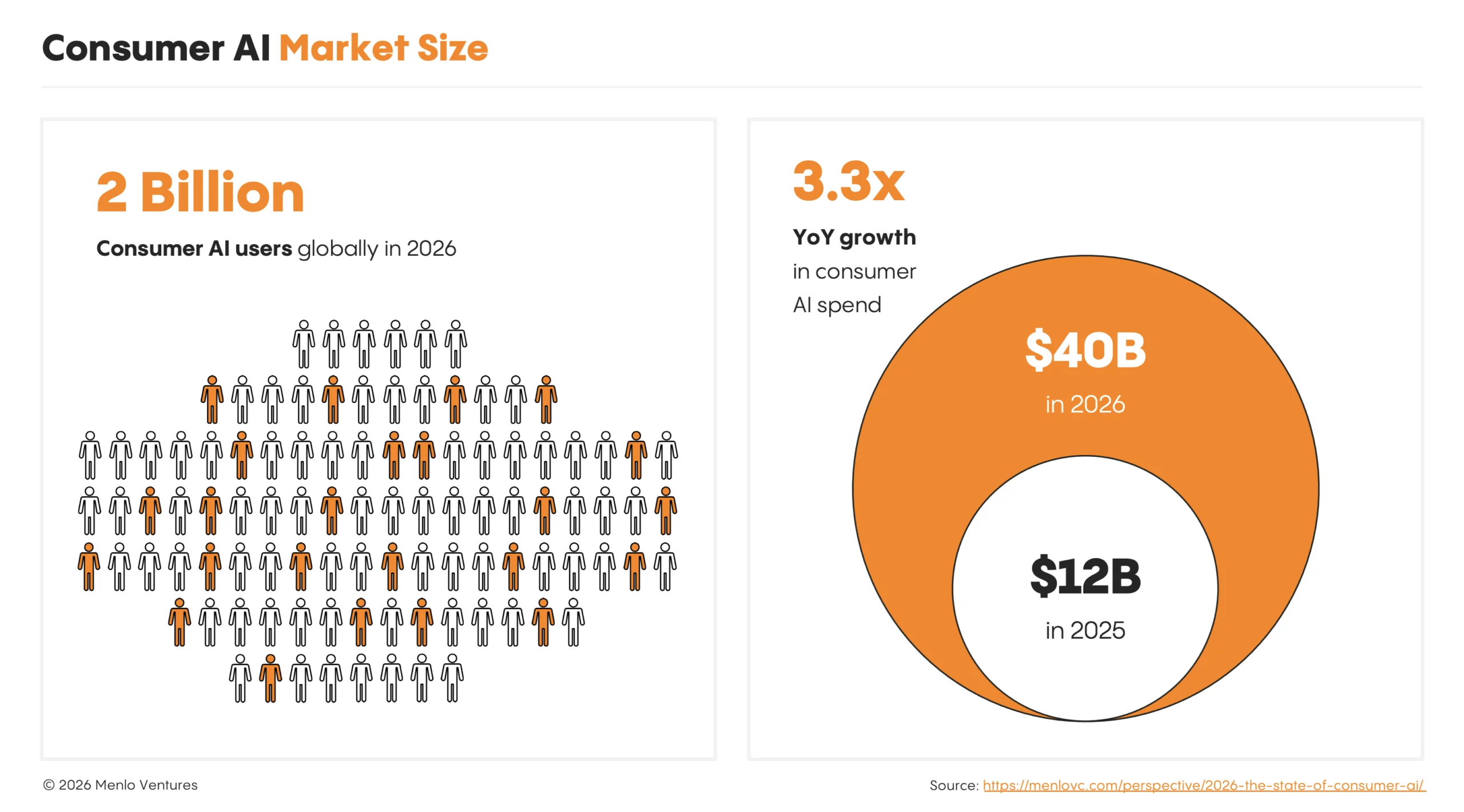
In 2025, consumer AI was a $12 billion market, 61% of U.S. adults had used AI, and nearly one in five Americans were using it every day. A category that barely existed a few years earlier was becoming part of daily life, but its reach was still wide and shallow.
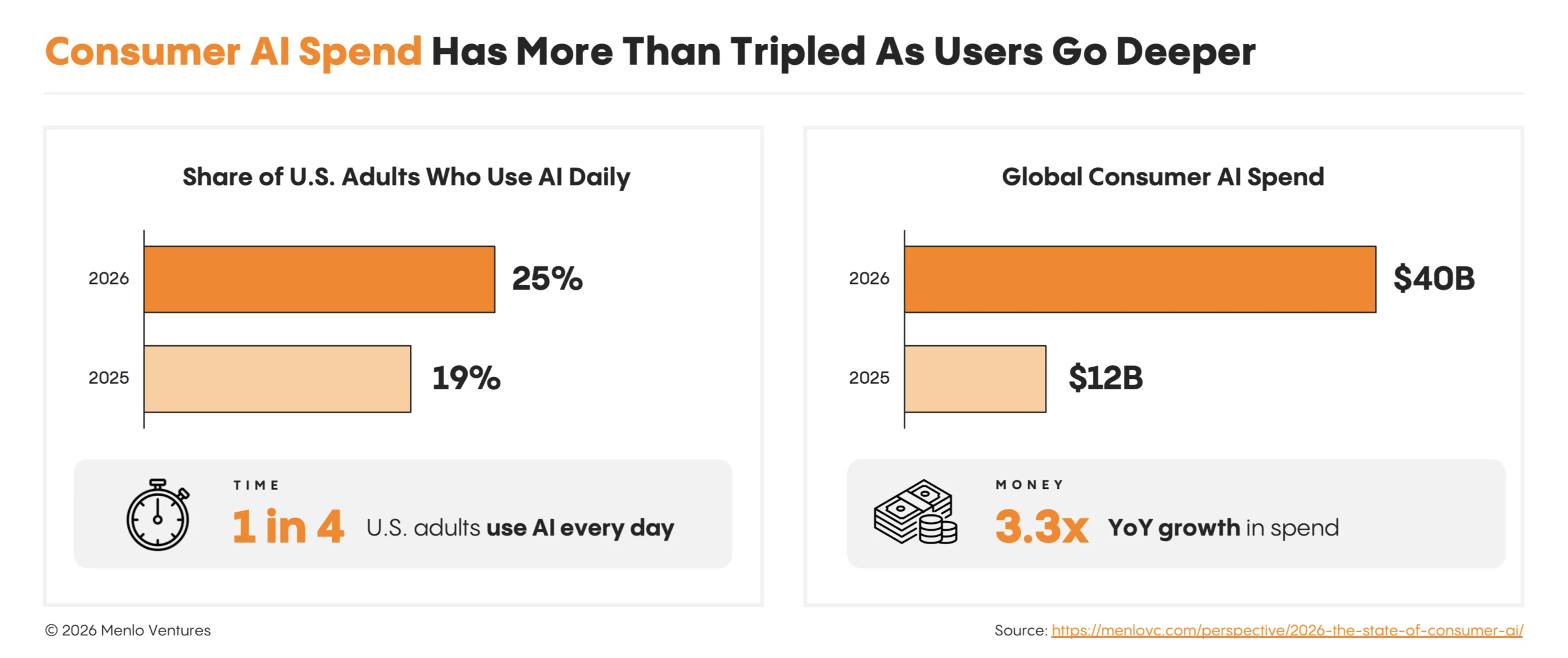
This year, consumer AI is going deep. We estimate consumer AI spend has reached $40 billion, more than triple what we measured a year ago. Most of that growth did not come from new users, as overall adoption rose just three points, from 61% to 64% of U.S. adults.1 Instead, growth came from existing users doing more with AI. Fifty-five percent of AI users, equivalent to roughly 90 million Americans, now pay for at least one AI product. Daily usage jumped from 19% to 25% in 2026, and 52% of AI users say they use it more than they did a year ago.
The story of consumer AI in 2026 is not how many people have tried it, but what happens once they do. Today, consumers are spending more time with AI, paying more for it, bringing it into more parts of their lives, and increasingly giving it the authority to act on their behalf.
Based on a survey of 5,067 U.S. adults, this report tracks that deepening relationship across four dimensions—time, money, tasks, and autonomy—and the trust that determines how far consumers are willing to go. See Methodology for additional survey details.
Time Spent: How Many People Use AI, and How Much?
One in Four Adults Now Use AI Every Day
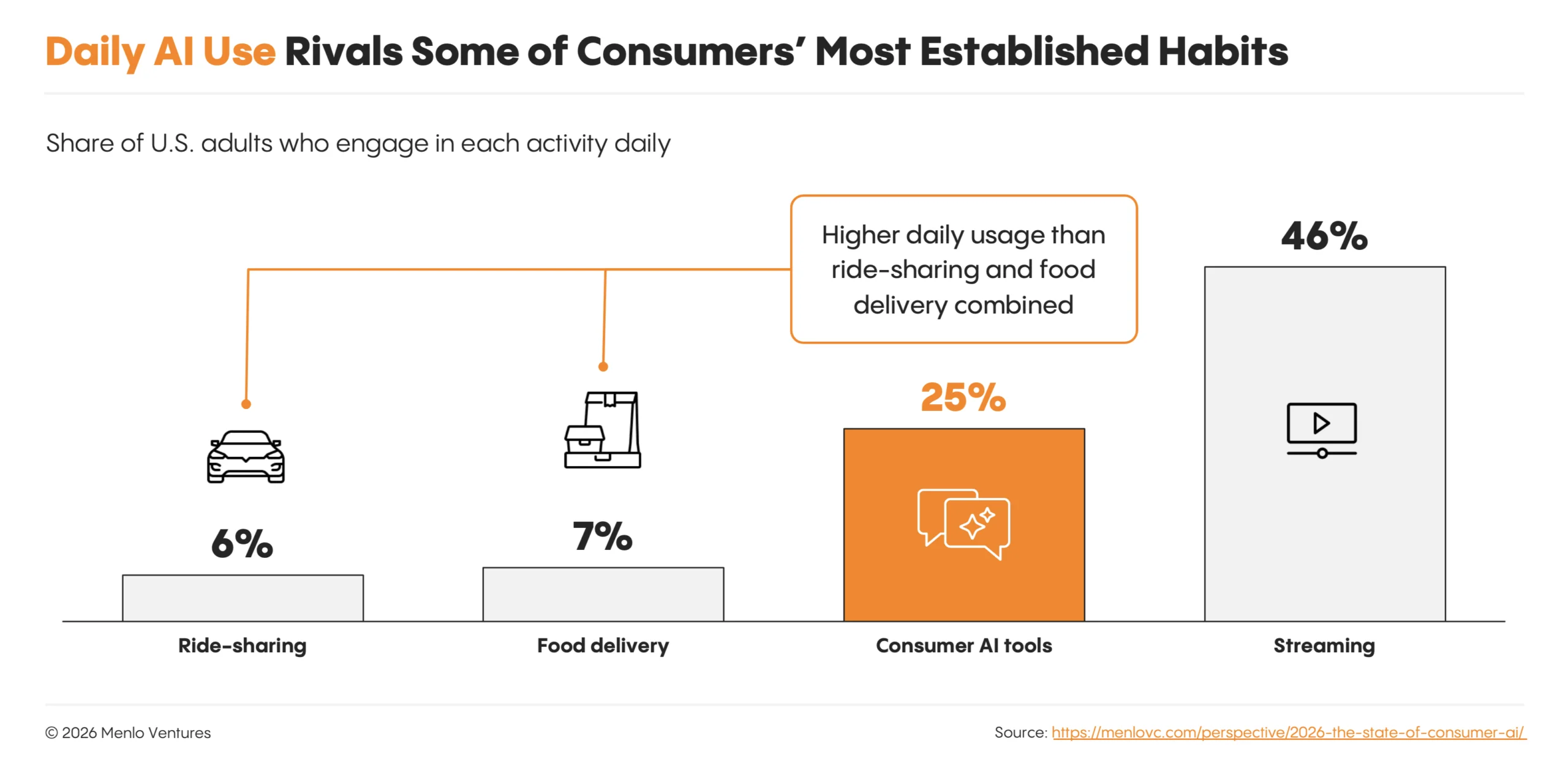
Twenty-five percent of Americans now use AI every day, up from 19% a year ago. Among AI users, daily usage rose from 31% last year to 39% today. General AI assistants alone2—setting aside task-specific tools like image generators and coding tools—are now used daily by 22% of consumers, more than ride-sharing (6%) and food delivery (7%) combined. For a category that barely existed four years ago,3 that level of habitual use is remarkable.
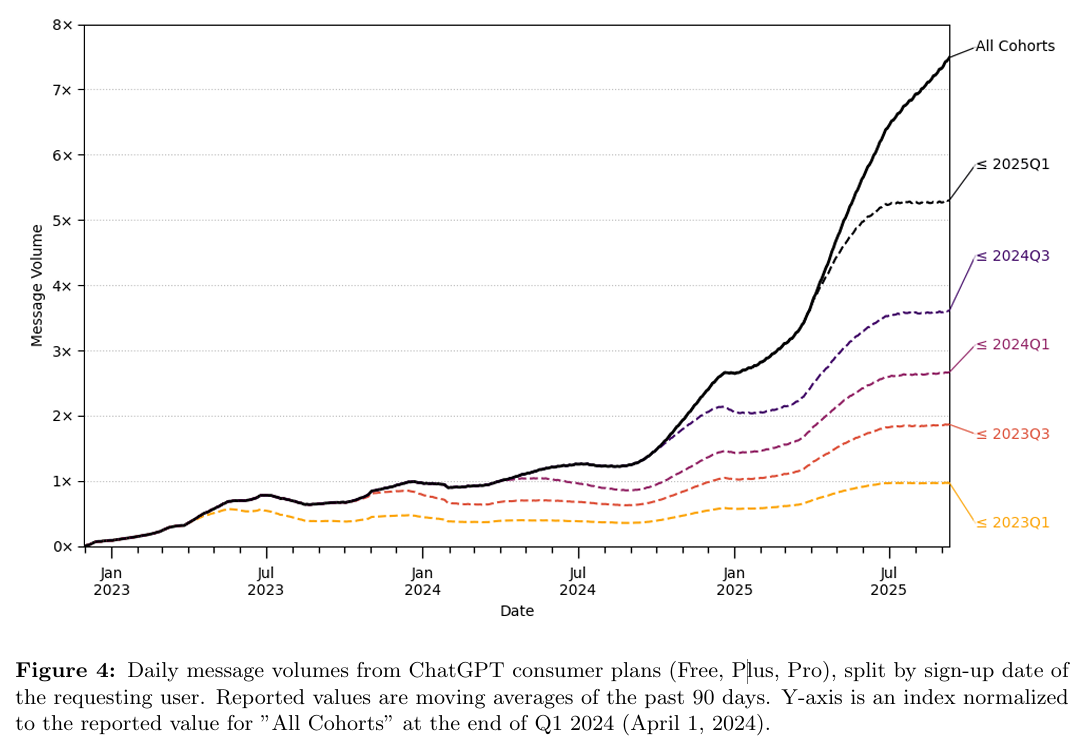
Time spent adds up, too. Nearly a quarter (24%) of AI users spend more than an hour a day with AI, and 10% spend more than two. More than half (52%) of AI users say they use AI more today than they did a year ago. We see the same pattern reflected in OpenAI’s own data from late 2025: Messages per weekly active user grew within every sign-up cohort, and the curve is still rising for cohorts more than two years past sign-up.
Accessibility makes deeper engagement possible: AI is now available on nearly every device within arm’s reach. Weekly use splits almost evenly between phone apps (56%) and computers (54%), while wearables, which was barely a category a year ago, now reaches 15% of AI users weekly.
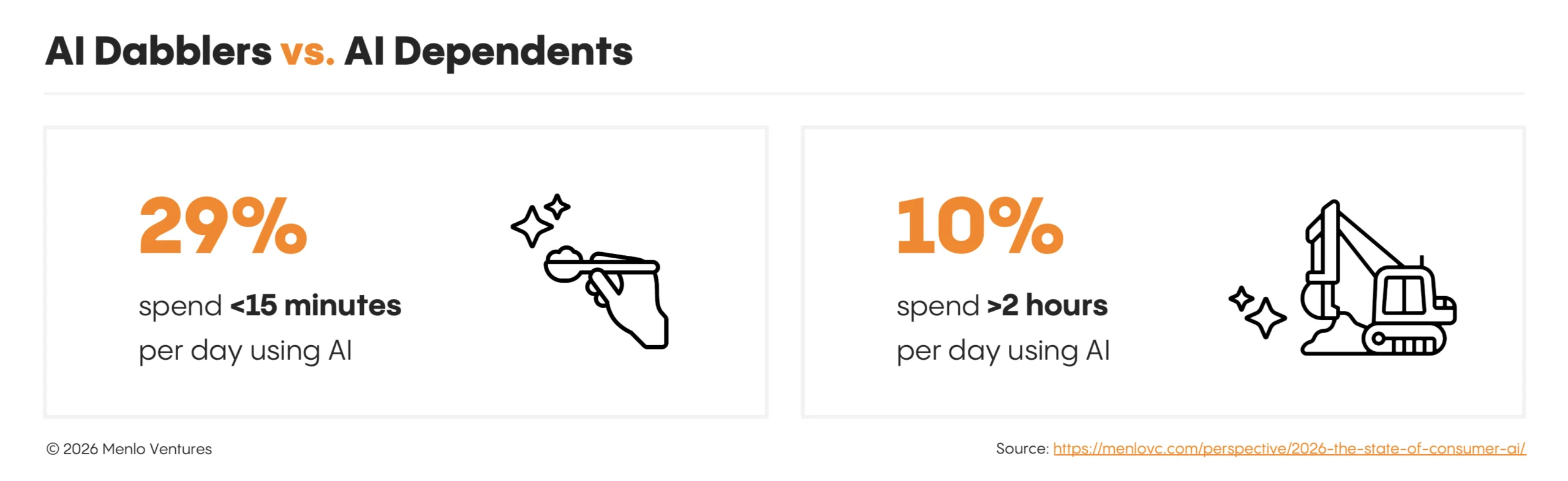
But that intensity is far from uniform. Ten percent of AI users now spend more than two hours a day with AI, while 29% spend less than 15 minutes. What looks like rising engagement at the market level is really a widening divide between AI dabblers and AI dependents.
For founders: The most important indicator of product-market fit is often how users engage with the product, not just how many show up. Metrics like sessions per week, minutes per session, and use cases per user can reveal depth, frequency, and habits in ways sign-ups alone cannot.
Money Spent: Which Consumers Are Paying, and How Should AI Be Priced?
Consumer AI Is Now a $40B Global Market, 3x Bigger Than a Year Ago
Global consumer AI spend reached $40 billion this year, more than 3x the $12 billion we measured a year ago. For context, app stores took eight years to reach that level of consumer spend; U.S. streaming took over a decade. Consumer AI got there in just three and a half years.
Almost none of that growth came from new users. The number of AI users globally grew just 11% this year, from 1.8 billion to 2.0 billion people, while consumer spend more than tripled. More users became payers, and payers paid more.
More Than Half of Users Now Pay for AI
More than half (55%) of AI users report paying for at least one AI product in 2026. That is a meaningful shift in a market where consumers have historically resisted paying directly for software, helping make advertising the dominant business model. Last year, AI looked no different: Just 3% of AI users paid.4 Today, the gap between adoption and payment is narrowing much faster than we expected.
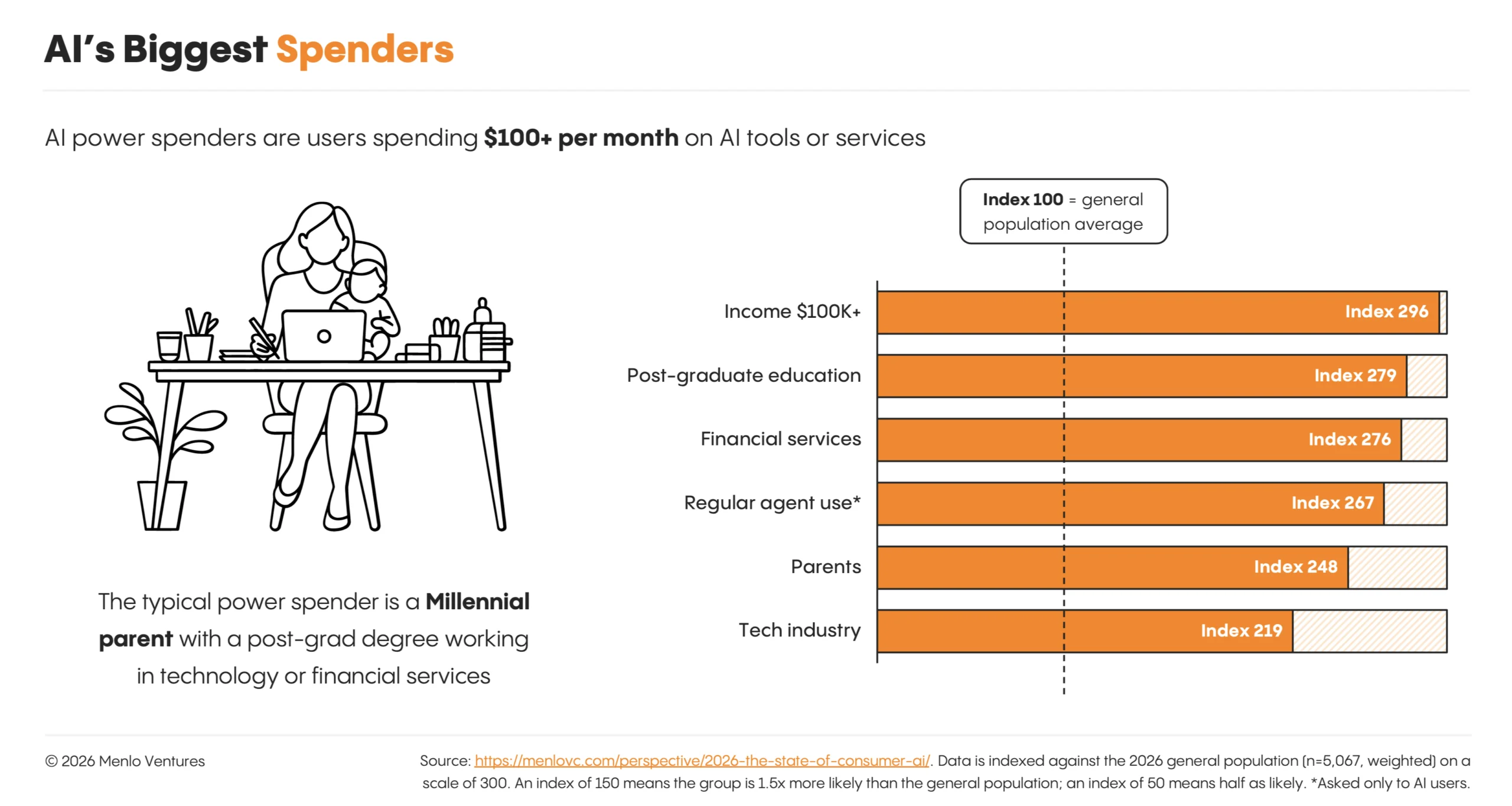
A small segment of consumers are driving the bulk of AI spend. The typical payer spends $20 to $49 a month, but today’s market is driven by power users: The 14% who spend $100 or more a month account for 60% of consumer AI spending.
The Consumers Most Likely to Pay
What’s more interesting than how many consumers pay is who pays, and why.
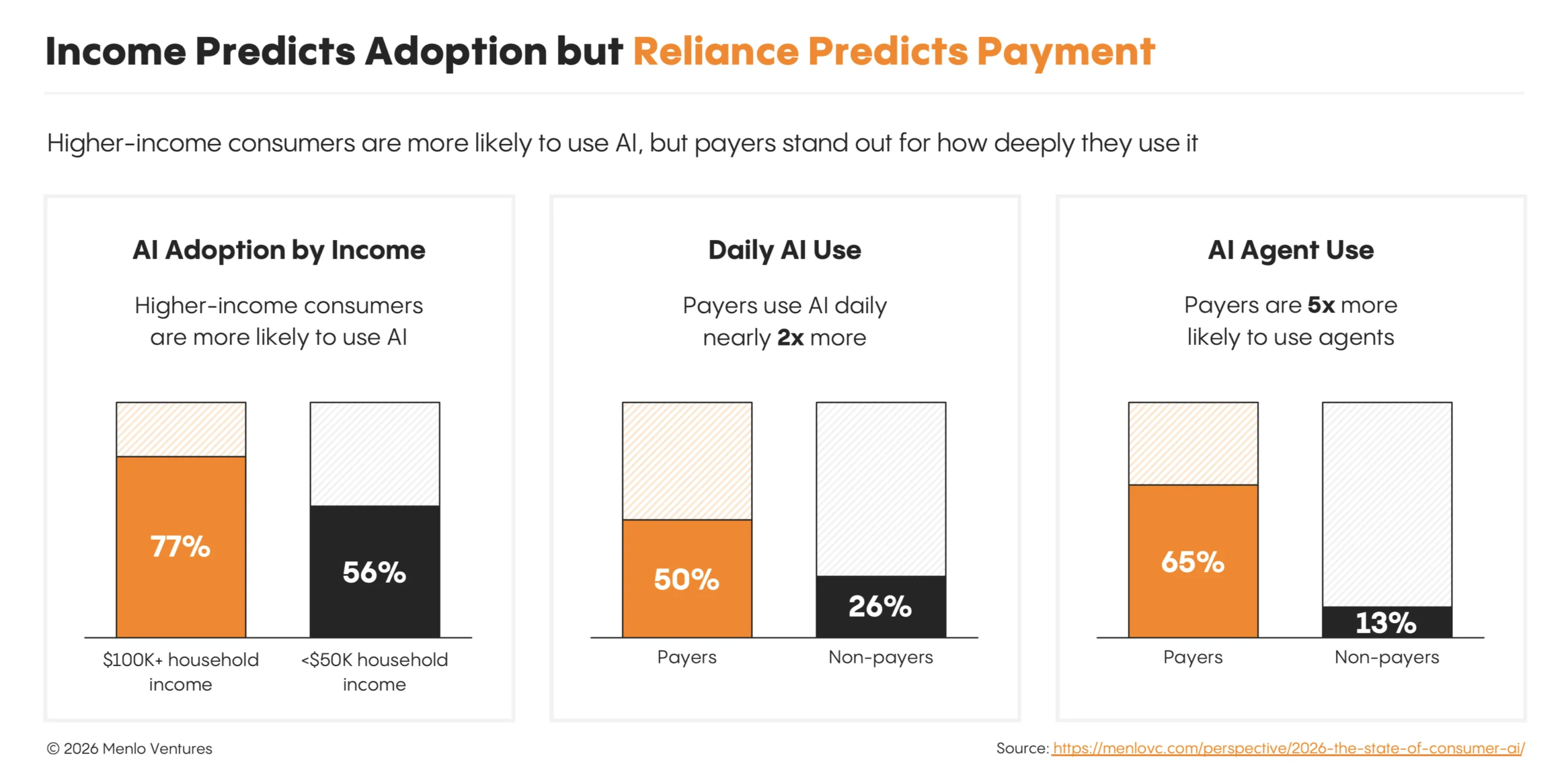
AI adoption still rises substantially with household income. Seventy-seven percent of consumers in households earning $100,000 or more use AI, compared with 56% of those in households earning under $50,000. But income is not the strongest predictor of who actually pays.
What separates payers from non-payers is how deeply AI is embedded in their lives. Payers use AI daily at nearly twice the rate of non-payers (50% vs. 26%) and use it across more parts of their lives. They are also far more likely to use AI agents: Among AI payers, 65% use an AI agent, compared with just 13% of non-payers.
Consumers appear increasingly willing to pay once AI becomes useful enough that losing access would hurt. That makes the free tier important for more than customer acquisition: It’s where users discover value, build habits, and, for some, become willing to pay.
At the extreme are AI’s power spenders: The typical user paying $100+ a month is a Millennial parent with a post-grad degree working in technology or financial services. They tend to have more money than time.
For founders: Keep the free tier. It’s where you prove value and nurture habits before asking them to open their wallets.
Who’s Footing the Tab?
Forty-eight percent of payers cover their AI costs entirely themselves.5 Another 34% have a family member or friend paying, while roughly 20% have an employer or school picking up the tab.6 And when employers or schools pay, they pay more: These users spend a blended average of $40 more per month—$95 a month compared to the $55 a month among those paying entirely out of pocket.
Who pays tells you where AI sits economically in someone’s life. If a parent or partner covers the subscription, AI has become a household expense. Consumer software has monetized that before: Monarch* offers a personal finance app for households to reduce the work of managing money together. Almost nothing in consumer AI is priced or designed around the household yet.
If an employer or school pays, AI has crossed into an institutional budget—even if the account itself began as a personal purchase. That creates a natural bridge from consumer adoption to enterprise spend.
For founders: A work email address used in a consumer signup is a strong signal. These users tend to spend more, use more AI tools, and can become the starting point for enterprise growth—from one user, to a team, to a company-wide contract. Companies like Lovable* have grown into the enterprise this way.
Subscriptions Are the Primary Pricing Model for Consumer AI
When it comes to AI monetization, consumer companies have largely settled on the subscription model. Today, 50% of payers are on flat monthly plans, while 26% hold annual ones. But these subscriptions do more work than a streaming-style flat fee. AI plans are tiered: Heavier users buy bigger allowances, and when they outrun even those, usage-based billing kicks in.
As a result, 15% of payers mix a subscription with usage charges, and some of the 17% on usage-based pricing are metered past a plan’s limits rather than paying per use from the start. The design solves consumer AI’s core pricing tension: Consumers want a predictable monthly bill, but serving the heaviest users costs real money. AI companies have allowed the subscription to price the access and the meter to price the excess.
For 48% of Users, AI Is a Source of Income
AI isn’t just another expense; nearly half of AI users (48%) say they’ve earned money with AI, most commonly through content creation (22%) and freelancing (18%). Gen Z AI users lead by a wide margin: 62% have earned money with AI, compared with just 15% of Boomer AI users.
That translates to roughly 30% of all U.S. adults, or about 79 million people that have used AI to supplement their income. For context, 27% of Americans reported having a side hustle of any kind in 2025, and that share was declining.7 Side hustles skew young, too, but nowhere near as sharply: 34% of Gen Z reported having one, compared with 22% of Boomers.
A 55% payer rate is easier to understand when AI isn’t just another expense, it’s helping people earn. ShopMy* offers a glimpse of what that can look like: Roughly 185,000 creators use the platform to earn commissions on the products they recommend, generating more than $1 billion in annual sales.
The Consumer AI Stack: Is Anyone Winning?
ChatGPT’s Lead Is Shrinking
General AI assistants are now universal among AI users: 96% used one this year, up from 92% in 2025. But which ones do consumers reach for?
Among AI users, ChatGPT remains the most widely used assistant at 60%, up from 45% last year,8 but its lead is narrowing. Gemini grew from 36% to 58% in 2026, cutting ChatGPT’s lead from nine points to just two. Claude* grew fastest, with usage nearly tripling from 7% in 2025 to 20% in 2026.
Our data also reveals that consumers are increasingly using more than one assistant. The average user now uses 3.0 general AI assistants, up from 2.2 a year ago.
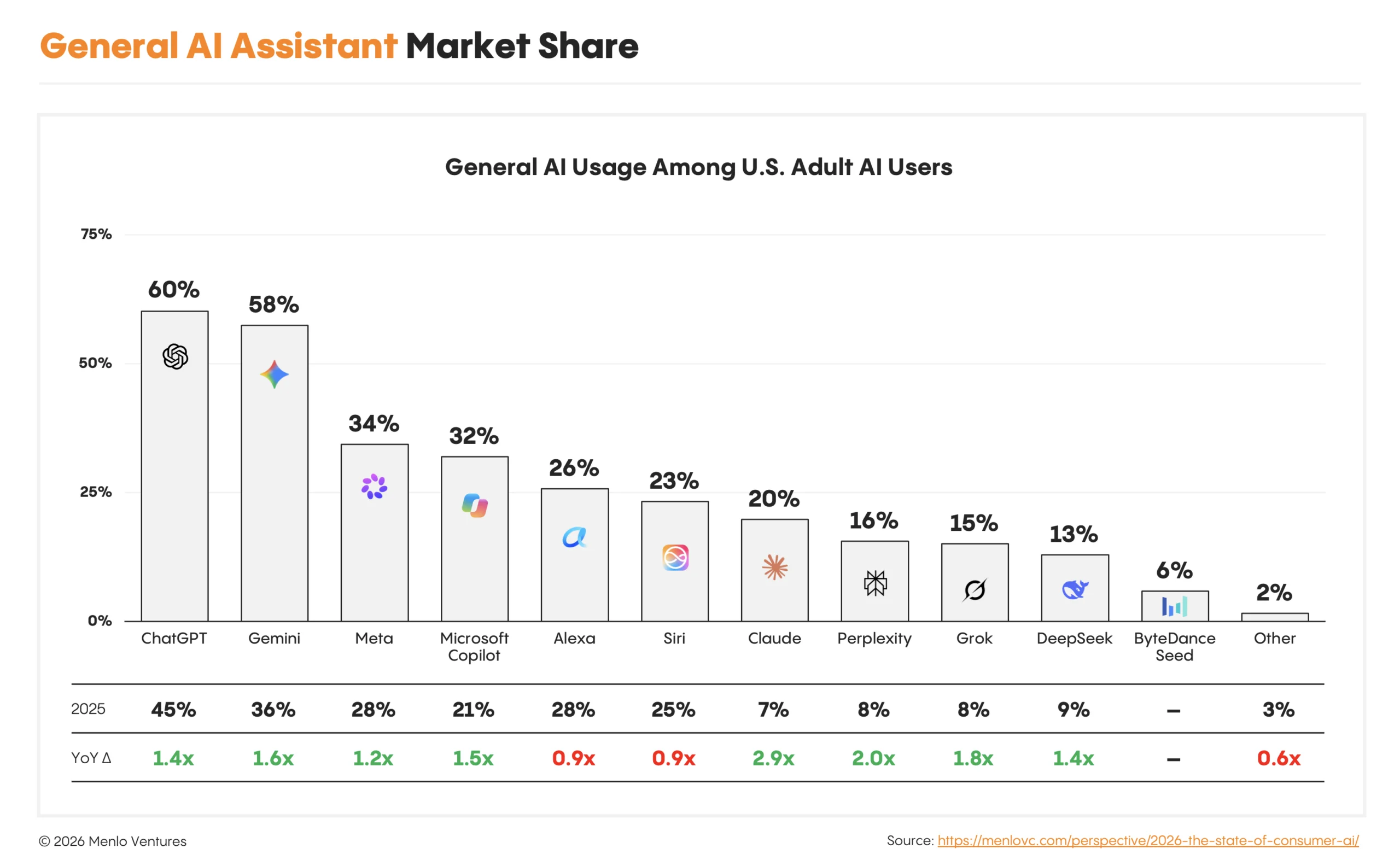
Gemini’s growth underscores the power of distribution. Google put AI everywhere—inside search, Android, and Workspace—reaching over a billion of consumers who never had to seek it out. Conversely, Claude nearly tripled its reach without that built-in distribution.
As a result, the consumers who opt for ChatGPT or Gemini versus Claude tends to have different profiles:
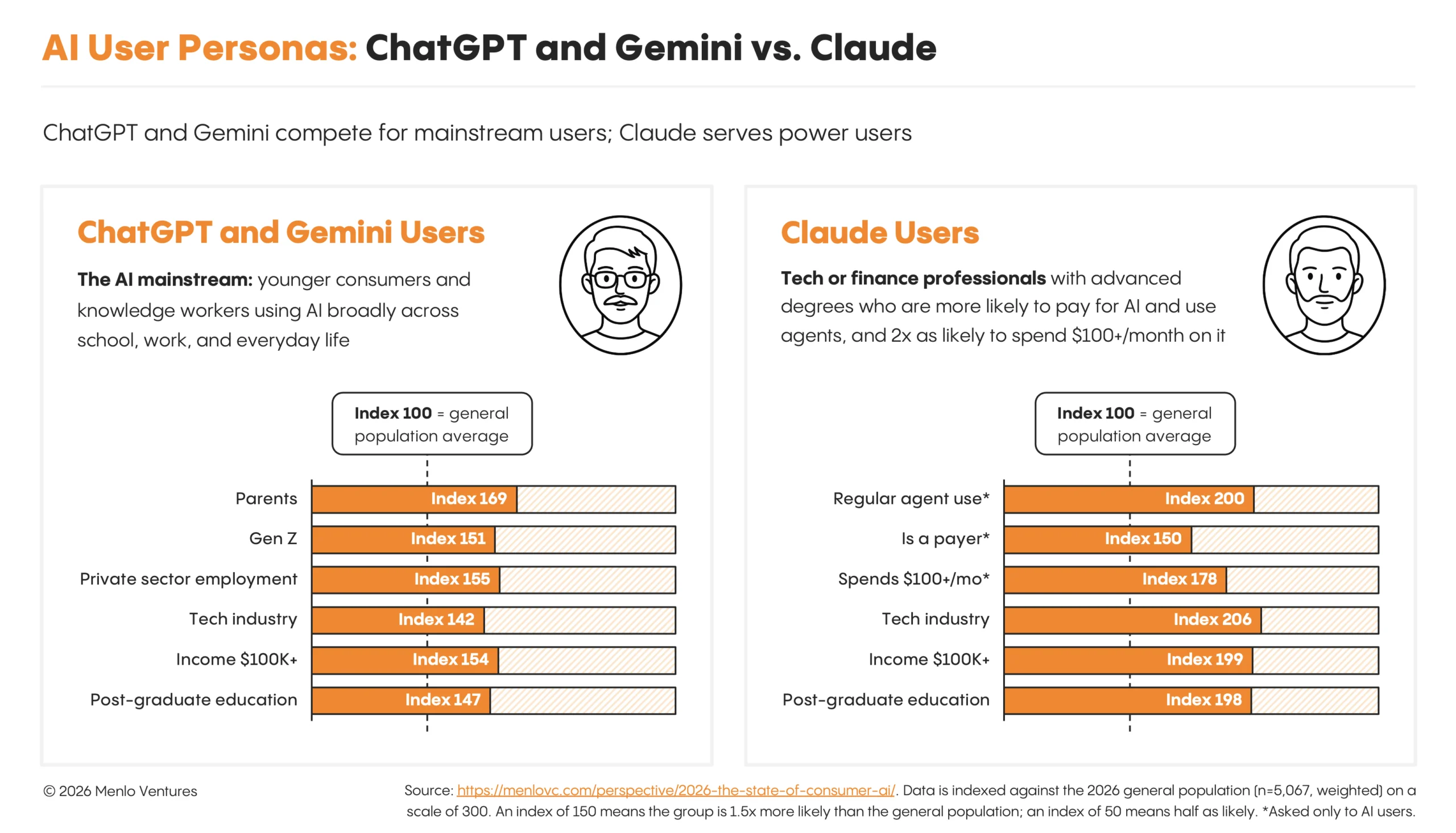
The archetypal ChatGPT user, according to our survey, is the market’s everyman. At 60% reach, ChatGPT’s base looks like the average AI user: younger and more likely to be a student or knowledge worker, spread across every income level and industry, using AI for school, work, and everything in between. Gemini users fit a very similar archetype, though they are, on average, a few years older. On income, education, occupation, and willingness to pay, however, Gemini’s base is nearly indistinguishable from ChatGPT’s—the two platforms are competing for the same user.
The archetypal Claude user is a different character. Our survey shows Claude users are more likely to be tech or finance professionals with an advanced degree, who treat AI as equipment rather than novelty. Claude users are more likely to pay for AI (82% do), more likely to run AI agents (48% do—1.5x the rate among ChatGPT or Gemini users), and twice as likely to spend $100+ a month on AI.
The Average Consumer Uses Multiple AI Tools
Last year, reach across the four general AI-native assistants (ChatGPT, Gemini, Claude, and Perplexity) summed to roughly 95% of AI users. This year, usage across these assistants adds up to more than 150%, as consumers increasingly use more than one. With ChatGPT and Gemini both above 50%, a large share of consumers necessarily use both.
Therefore, it’s important to rethink how we interpret reach. Traditional market share assumes that one company’s gain comes at another’s expense, but consumer AI looks different: Reach tells us whether a product is present in a user’s rotation, not whether it owns that user.
The same pattern is playing out between general AI assistants and specialized AI applications. Specialized AI usage increased from 69% in 2025 to 75% in 2026, while the share of AI users using both general and specialized products jumped from 60% to 72% over the same period.
We used to think that negligible switching costs created a vulnerability for specialized applications. If consumers could move freely between products—and increasingly capable general AI assistants could absorb more functionality—specialists risked being squeezed. But our data suggests that, when switching is free, so is adding. Consumers don’t need to abandon ChatGPT or Gemini to adopt a tool that does one job materially better. In fact, general AI assistants may be creating customers for specialized applications by teaching consumers what AI can do and giving them reasons to seek better products for particular workflows.
There is an important distinction here between a rotation and a stack. A general AI assistant in the rotation competes for queries. A specialized product in the stack can own a workflow. For application companies, that is a much more encouraging market structure than winner-take-all.
For founders: A seat in the rotation means winning one job at a time—and doing it materially better.
Nearly Half of AI Users Now Speak to AI
Consumers are talking to AI more than ever. Our 2026 survey finds that 19% of AI users say voice is their primary way of interacting with AI, while another 27% move between voice and typing. In other words, nearly half (46%) of AI users speak to AI at least some of the time, but the talking isn’t happening on smart speakers. It’s happening inside the AI apps themselves, through voice modes, dictation, and spoken prompts inside chat interfaces. Voice is also the rare interaction mode that doesn’t decline with age: 25% of AI users 65 and older count it among the ways they use AI most, compared with 23% of Gen Z.
At the same time, traditional voice assistants are losing ground. Alexa usage fell from 32% to 22%, while Siri* declined from 25% to 20%. Siri and Alexa’s decline is telling: Model quality does not appear to be the constraint. Despite major upgrades in the intelligence and capabilities of both products, people were trained to use Siri and Alexa to set timers and play songs, so they stopped expecting more from them. Breaking that habit requires more than better models; it requires retraining customers to trust them with bigger jobs.
Wispr Flow* earned that trust with the lowest edit rate in dictation (users rarely have to go back and fix a word) and a hot key that works across any app on the desktop. Once the transcript comes out right the first time, people start dictating emails, prompts, and documents they once would have typed.
For founders: Pick a job or modality where you can be 10x better than a general AI assistant, and expand from there.
Tasks Handled by AI: Which Jobs Are Consumers Handing Over, and Which Are They Keeping?
Top AI Use Cases by Adoption: AI Is Managing and Doing
AI use grew across every category of daily life we track—Routine Tasks, Physical and Mental Health, Learning and Development, Connection, and Creative Expression. Every activity we began tracking last year saw a statistically significant increase in usage.
But the more interesting story is where behavior moved fastest. Last year, administrative tasks topped the list: Writing emails was the #1 activity, cited by 19% of consumers, with managing to-do lists close behind at 18%; organizing notes and managing expenses also ranked among the top 10. Those uses continued to grow, but this year, the biggest gains came from discovery and creation.
Our 2026 report captures a shift in consumer behavior: For many consumers, AI is no longer just a tool for outsourcing tasks; it’s a way to expand what they can do.
Top AI Use Cases by Penetration: Six Activities Are Now Mostly Done With AI
Another way to read adoption is to ask not how many people use AI for a task, but what share of the people who do that task now use AI to do it. That penetration rate shows where AI is becoming the default.
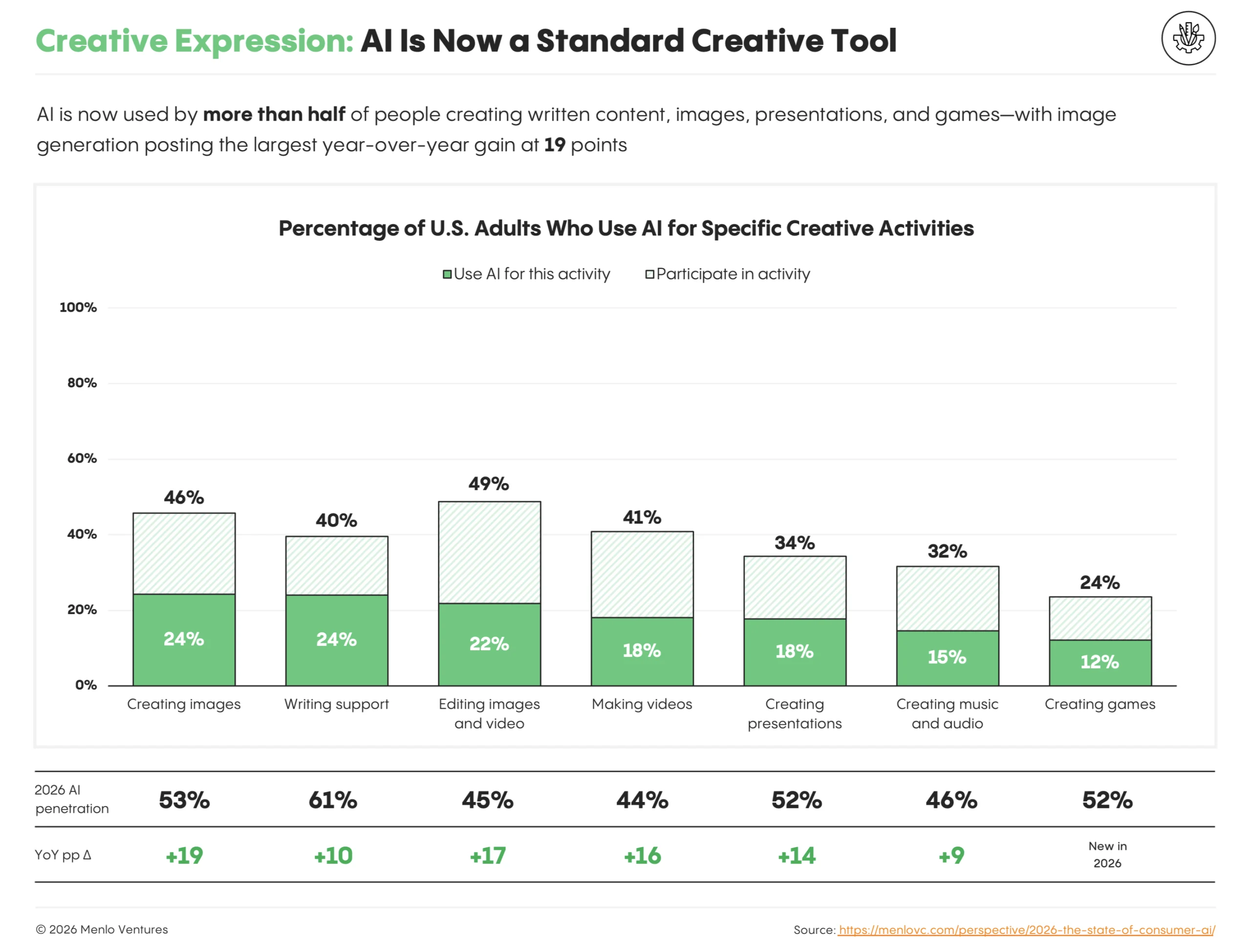
On that measure, six activities have majority AI use. Writing support leads at 61%, followed by coding projects (58%), getting help with school and work assignments (56%), image creation (53%), presentation building (52%), and game creation (52%). In 2025, only writing support did.
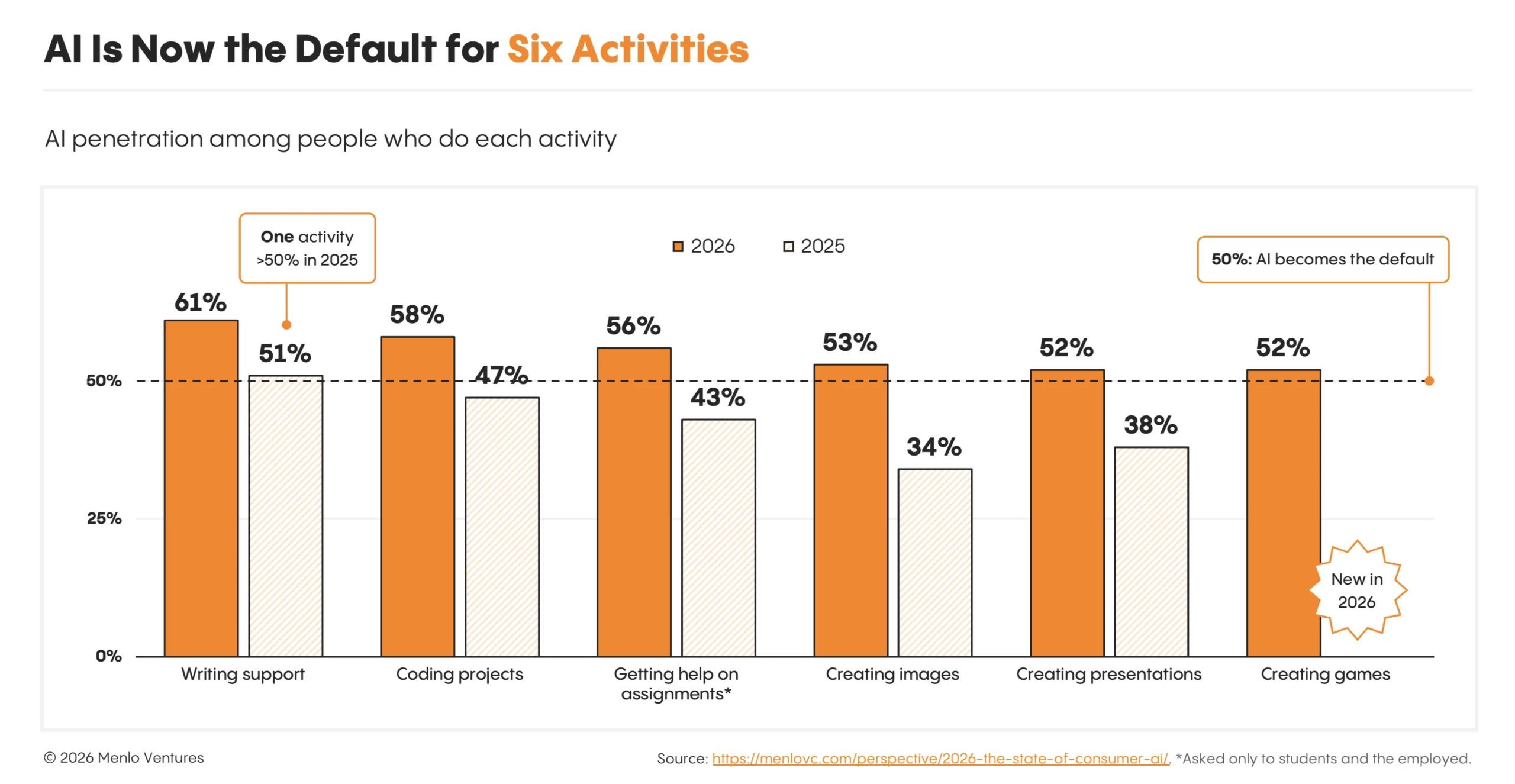
Crossing 50% changes what a product competes against. Below majority adoption, an AI tool is still competing with the manual way of doing something. Above it, the manual method becomes the fallback, and the competition becomes any AI that can do the job—including the general AI assistant the consumer already has open.
Routine Tasks: AI Is Doing Everyday Tasks End to End
Much of what consumers hand to AI is boring, everyday work: email, meal planning, shopping, household logistics. But because these tasks recur day after day, AI can quickly move from an occasional solution to an everyday habit.
Email is a good example: Drafting (47%) and editing (44%) are still the most common uses, but some users are turning to products like Town to let AI send messages, schedule meetings, or triage their inbox.
Shopping shows us just how far consumers will let AI go. In 2026, 50% of shoppers who use AI used it to compare prices and 43% to narrow a shortlist, 37% made a final purchase decision based on its recommendation, and 26% let AI complete a purchase. Alta* has found a wedge into fashion as an AI stylist that works from a shopper’s own closet, identifies wardrobe gaps, and lets shoppers buy its recommendations directly in the app.
These everyday tasks are where consumers first get comfortable letting AI make decisions and act on their behalf.
Learning and Coding: AI Is Producing More Builders
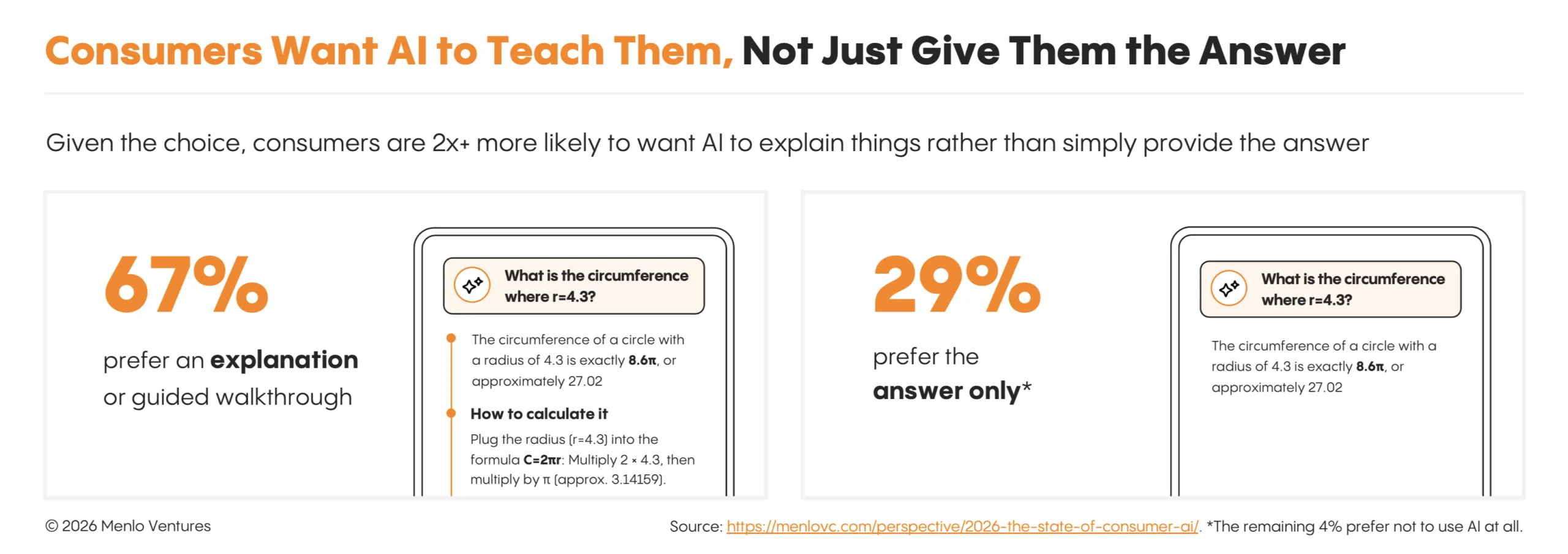
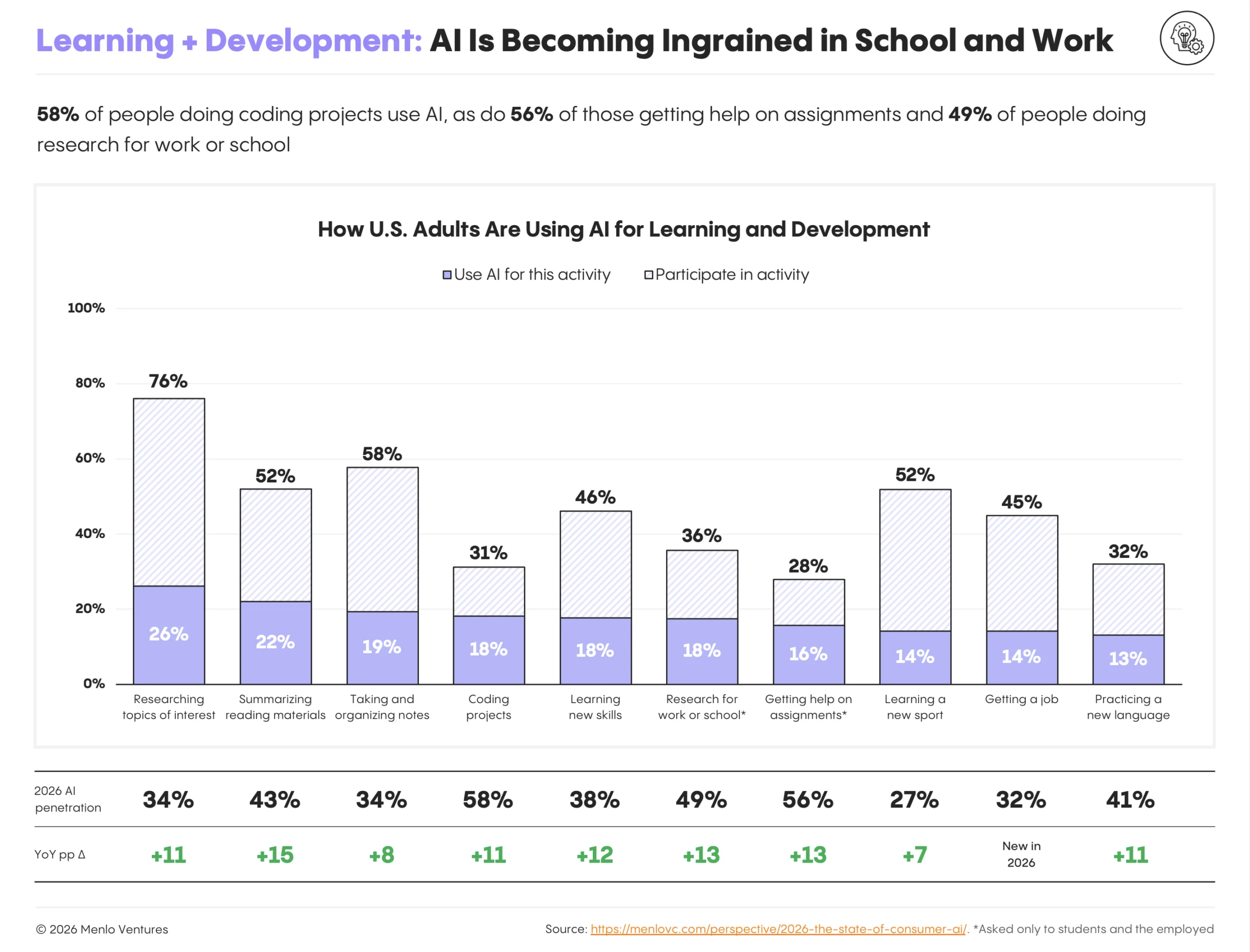
The single most common thing people do with AI is learn something new. In 2026, 26% of U.S. adults used AI to research topics of personal interest, making it the most common AI activity we measured. And people want more from AI than just a quick answer: When consumers are asked how AI should teach them new concepts, 67% chose an explanation or guided walkthrough while just 29% opted for the answer alone. That helps settle a question that has followed AI from the start: Does it help people learn, or help them avoid learning? The majority don’t want to outsource their thinking; they want to learn.
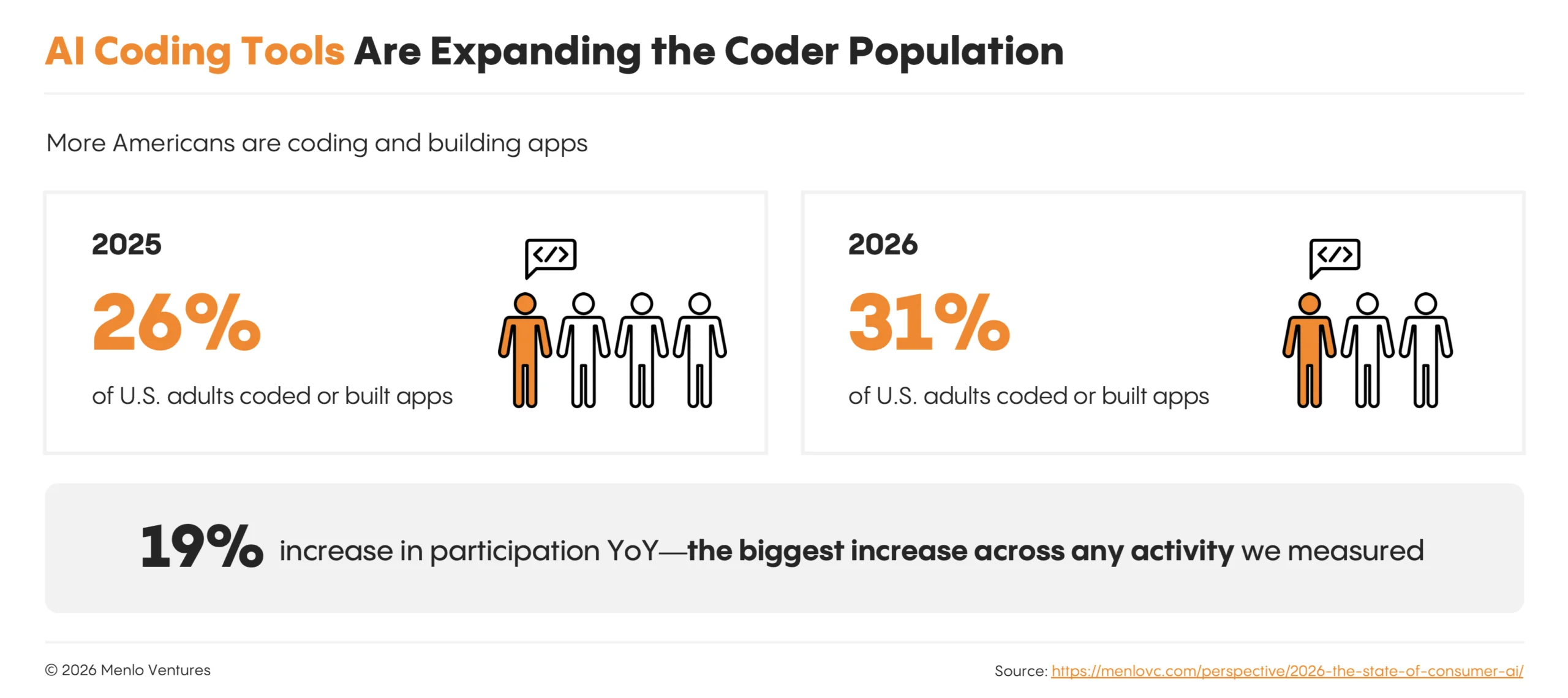
Learning is also quickly turning into skill-building. Fifty-seven percent of people who code for work or school now do it with AI, along with 49% of hobbyist coders. Last year, we predicted AI would quickly expand the market for coders and led investments in companies like Lovable that pioneered this wave. Now, we’re starting to see this show up in our own data. Last year, roughly one in four Americans coded or built apps for work, school or personal use. In 2026, this number is now approaching one in three, a 19% jump—the biggest increase in participation across any activity we measured.
Creative Expression: More Consumers are Becoming Creators and Monetizing their AI content
Creative work is where AI has gone deepest. Among consumers who believe that AI has improved their lives, 36% cite “creativity and self-expression” as a reason why—second only to the ability to learn new things (56%). AI now plays a role in more than half of several creative activities: 61% of writers use it, as do 53% of image-makers, 52% of people building presentations, and 52% of game creators. Even video, the lowest of the creative activities we track, stands at 44%.
Creative Expression was also our fastest-growing category this year. Image creation led the way, with AI use rising from 34% to 53%—the biggest single-year gain in the study.
That demand for greater creative capability has helped produce some of the fastest-growing companies in consumer AI. Suno* can turn a prompt into a finished song; Higgsfield* does the same for cinematic video. Both put sophisticated creative production within reach of people who may never have had the skills or tools to do it before.
And, increasingly, consumers are making money from what they create. Across every age group, content creation is the most common way users earn money with AI. In 2026, 22% of AI users reported earning money through AI-assisted content creation.
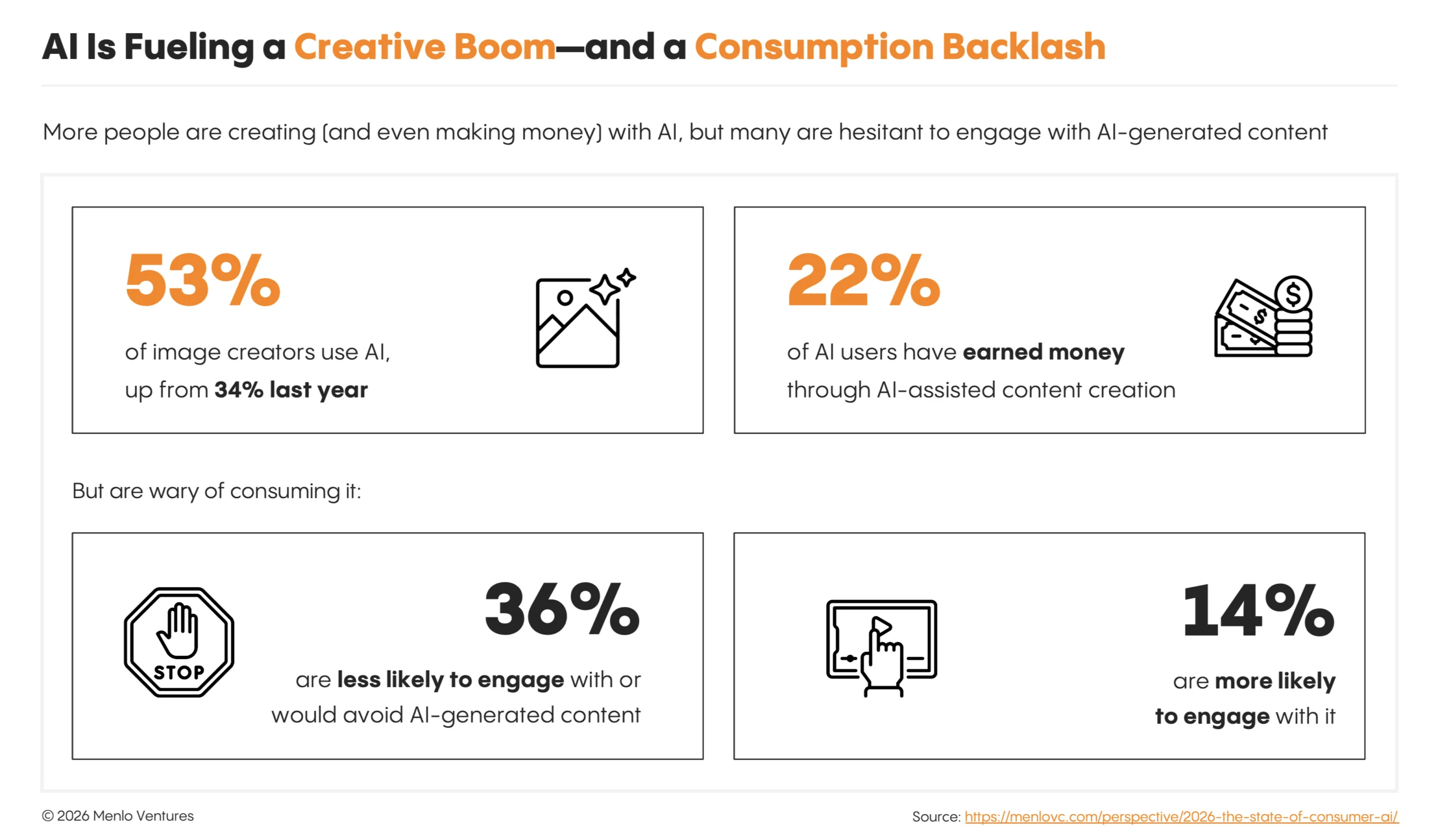
But abundance creates a new problem: Consumers are producing more AI content, but are increasingly wary of consuming it. Told that something was AI-generated, 36% of Americans said they’d be less likely to engage with it or would avoid it; only 14% said they’d be more interested. That makes provenance increasingly important, creating opportunities for tools like Pangram*, which detects AI-generated text and images.
Health: Consumers Consult AI, But Still Prefer Human Care
A year ago, health was one of the weakest areas of AI adoption. This year, it saw one of the biggest jumps we measured: Using AI to answer health questions rose from 14% to 25%, while using AI for mental health support climbed from 8% to 14%.
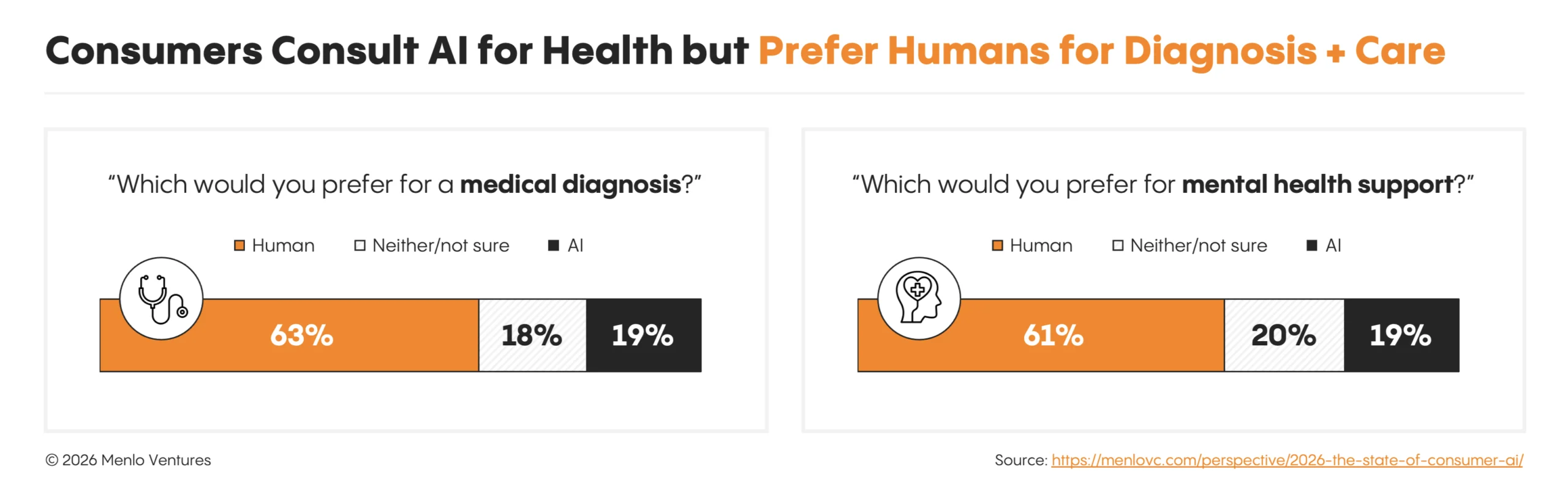
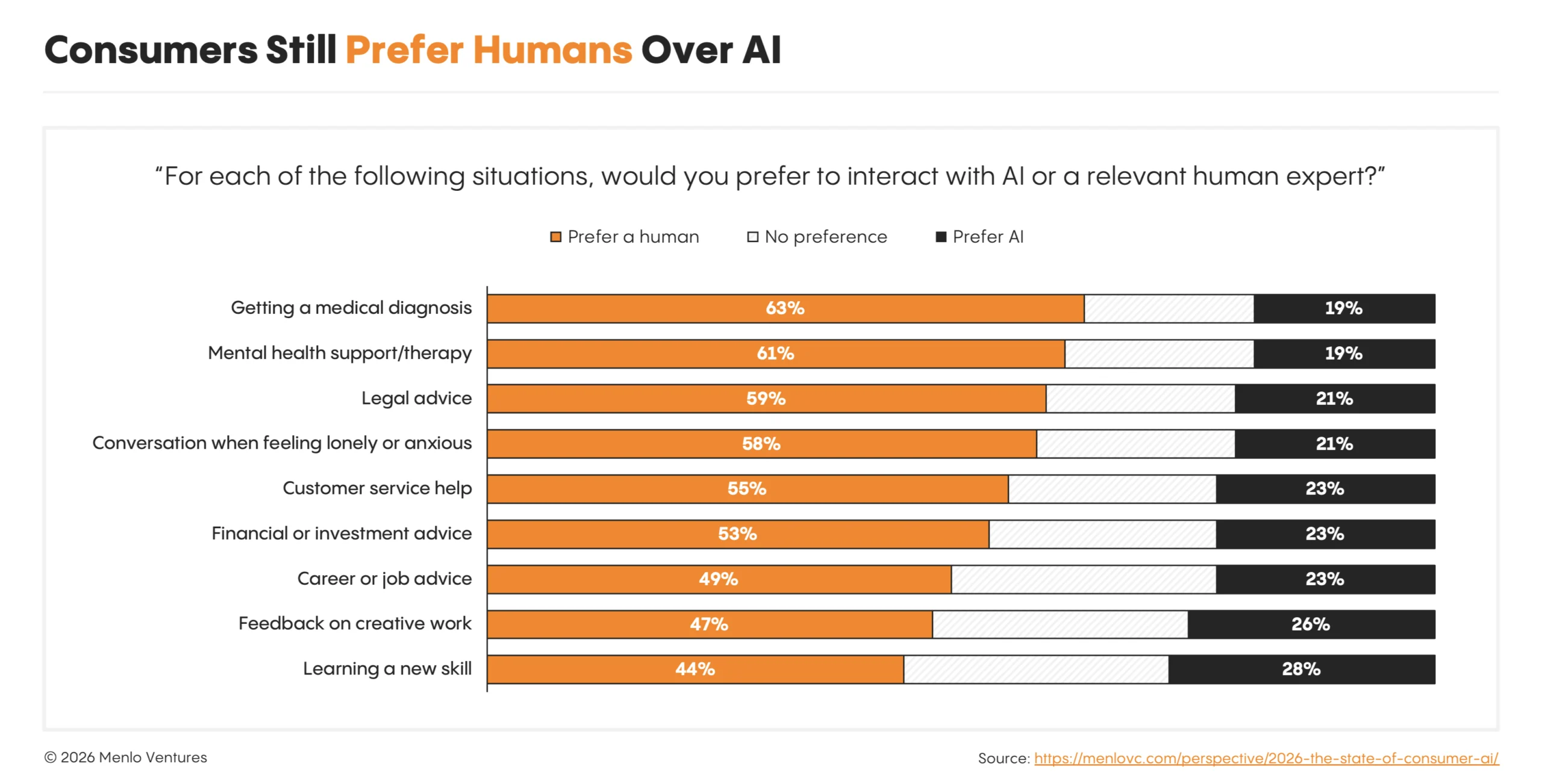
But consumers still draw a clear line between information and expertise. Asked whether they would prefer AI or a human for a medical diagnosis, 63% chose the human and just 19% chose AI, with the remainder expressing no preference. The split is nearly identical for mental health support: 61% prefer a human versus 19% AI, with the remainder expressing no preference.
Instead, consumers are using AI to research, interpret, track, and prepare—while leaving the final judgment to a human. Ash*, an AI for mental health support, and Function Health*, which pairs lab testing with AI-driven insights, are built around that same division of labor: AI helps consumers understand and manage their health, but for now, they still want a human providing the care.
Connection: AI Is Helping People Connect With Others and Becoming a Companion Itself
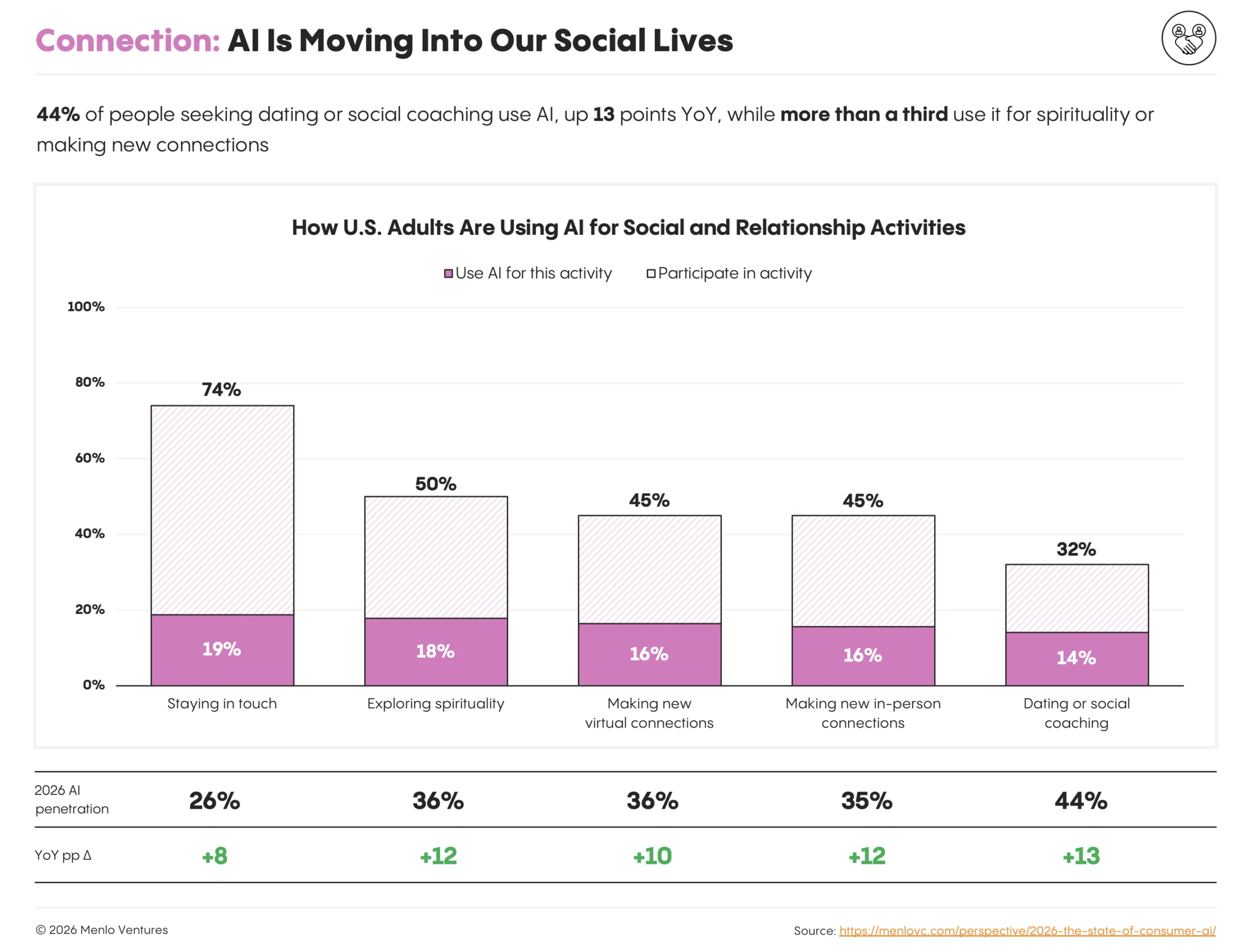
Connection remains the smallest of the five categories, but every activity within the category grew this year. Use cases range from 14% of Americans using AI for dating and social coaching—where AI penetration is highest within the category—to 19% using it to stay in touch.
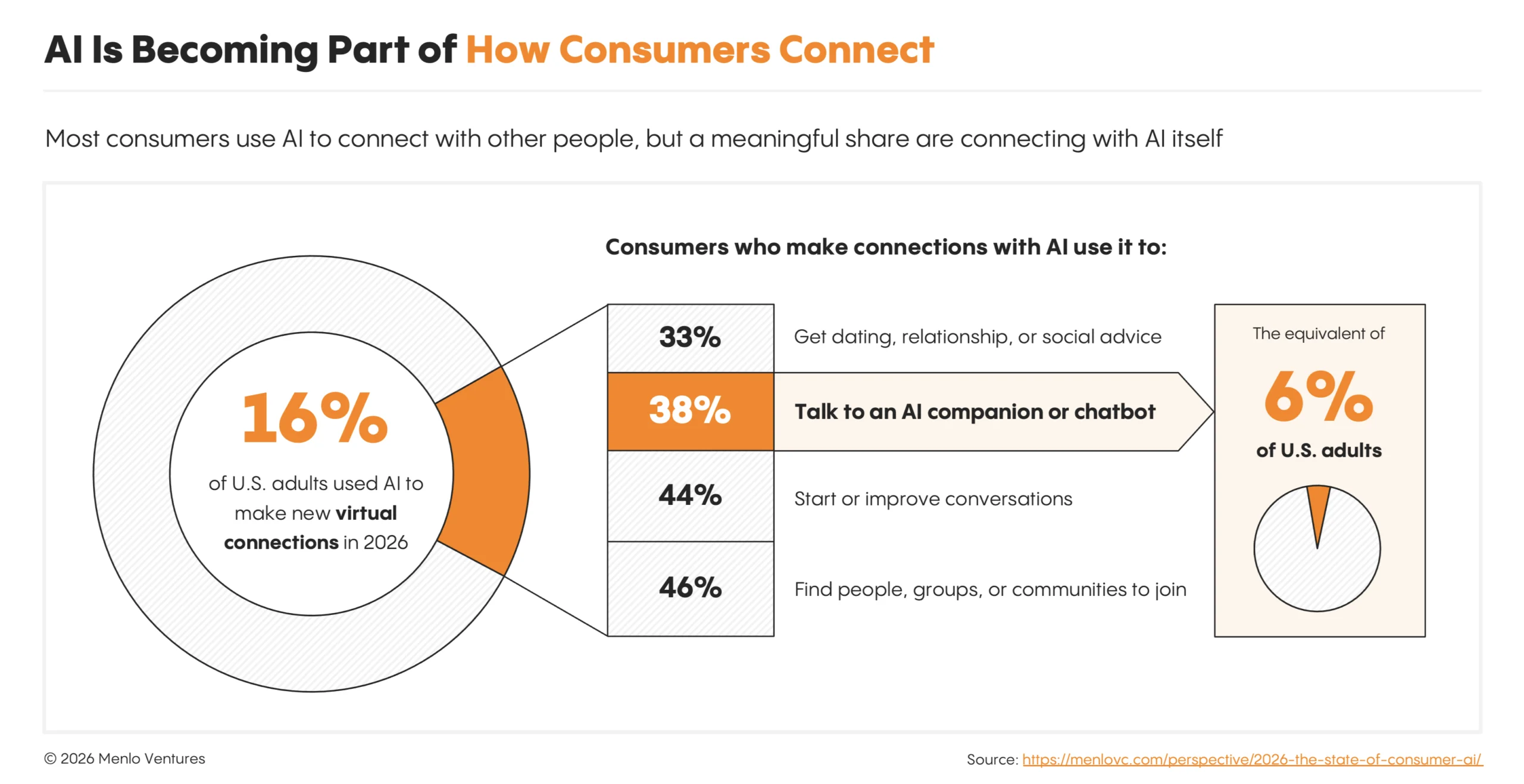
One behavior stands out: 16% of consumers used AI to make new “virtual connections” this year. For most, that meant using AI to connect with real people: 46% used it to find people, groups, or communities to join, 44% to start or improve conversations, and 33% for dating, relationship, or social advice.
For others, though, virtual connection meant something different: connecting with the AI itself. Thirty-eight percent of these respondents said they had talked with an AI companion or chatbot—equivalent to roughly 6% of Americans already engaging in a behavior that barely existed four years ago, enabled by products like Character.AI, Nomi, and Replika.
Trust Shapes Consumer Choice, Determines Winners, and Drives Growth
Trust Determines How Deep Consumers Go With AI
This year, consumer AI grew almost entirely because consumers went deeper with it—more time, money, use cases, authority. How much deeper they go from here depends on how much they trust it.
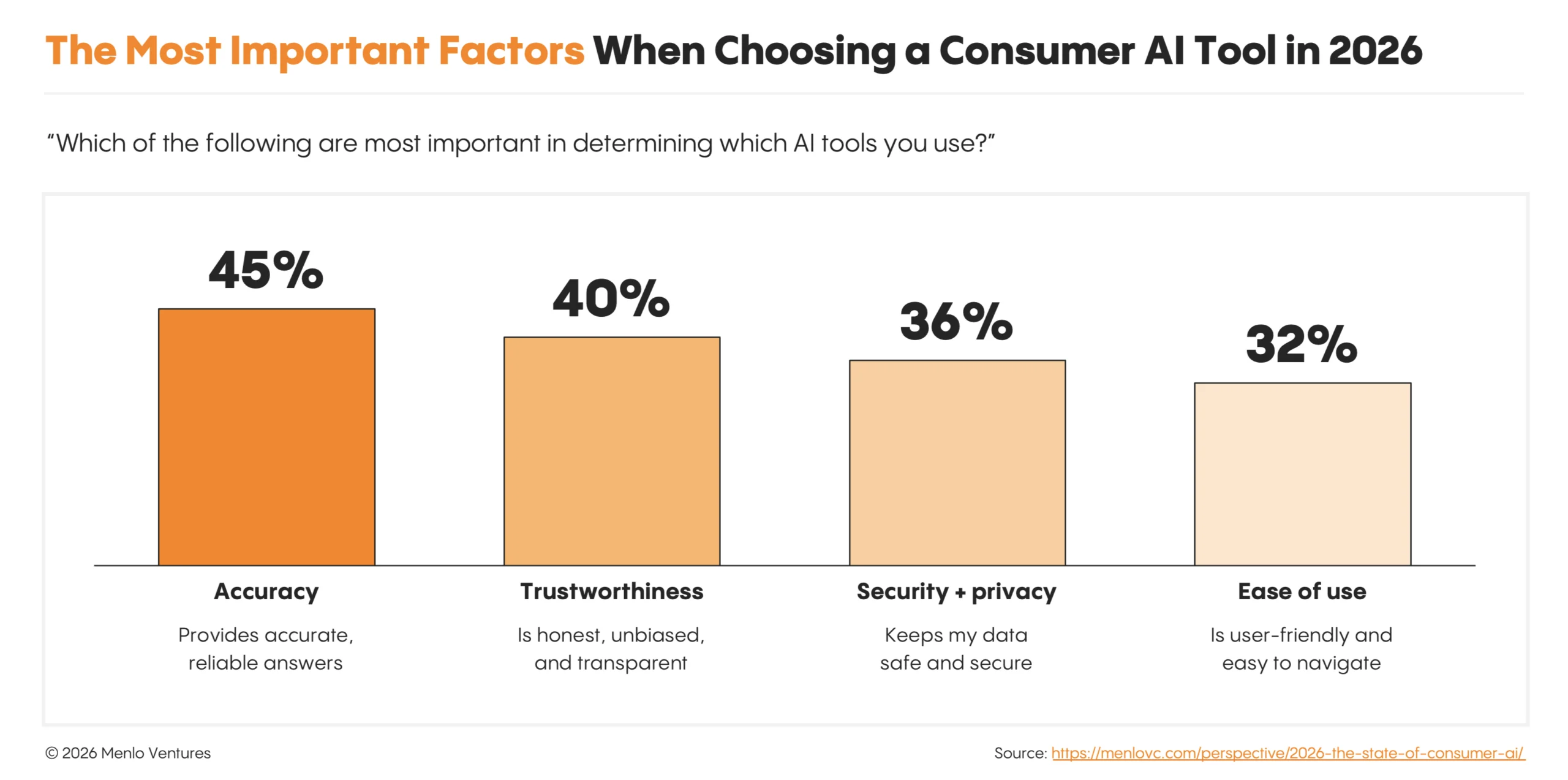
In 2025, consumer AI was about reach and awareness as ease of use outranked trustworthiness and privacy. In 2026, accuracy leads at 45%, followed by trustworthiness at 40% and security and privacy at 36%. Ease of use fell behind all three at 32%. The shift makes sense given what consumers increasingly bring to AI. A low-stakes request (e.g., a recipe, draft email, packing list) does not demand much trust. Health questions, financial decisions, purchases, personal communications, and access to private accounts are different.
As AI usage intensifies, consumers are increasingly judging AI on three questions:
- Can they trust what it tells them?
- Can they trust it with sensitive information?
- Can they trust it to act on their behalf?
The savviest consumer AI companies answer all three questions for you. Most assistants wait for a task and then carry it out at the user’s request. Instinct, whose beta launched in August 2026 and spread fast among early adopters who seek capability over caution, doesn’t wait. It works out what a user will need and offers to solve it before they ask. A new user experiences the “magic” of a proactive agent and doesn’t have to actively decide if they trust it; they simply see the benefit of doing so. Town brings the same proactive design to professional work, and with the security and guardrails a work tool requires. While the jobs are different, neither platform waits for trust to build on its own.
For founders: Asking for permissions can be a double-edged sword. The more you ask for, the more value you can deliver. At the same time, the more you ask for, the more the consumer needs to trust you to say yes. Start with the data your core job requires, earn the permission to access it, and expand from there.
Specialized Products Lose on Trust, Not Awareness
Among AI users who exclusively use general AI assistants, awareness isn’t what’s holding them back. Only 11% say they’re not aware of specialized products that meet their needs. In fact, specialized products are often losing out to data privacy concerns with niche or lesser-known tools (27%) and not knowing which tool to trust (21%).
A specialized product can be objectively better at a job and still lose to a familiar assistant. As model capability spreads and features become easier to copy, trust, proprietary context, workflow ownership, integration, and demonstrably better outcomes become increasingly important sources of differentiation.
Low Penetration Doesn’t Mean Pent-Up Demand
The three activities with the lowest AI adoption are also things most Americans do. About 80% of Americans pay bills, 75% stay in touch with people, and 69% navigate the healthcare system. Yet AI penetration remains low: Just 23% of people who navigate healthcare use AI to help, along with 23% of bill payers and 25% of those staying in touch. On paper, these look like some of the biggest openings in consumer AI.
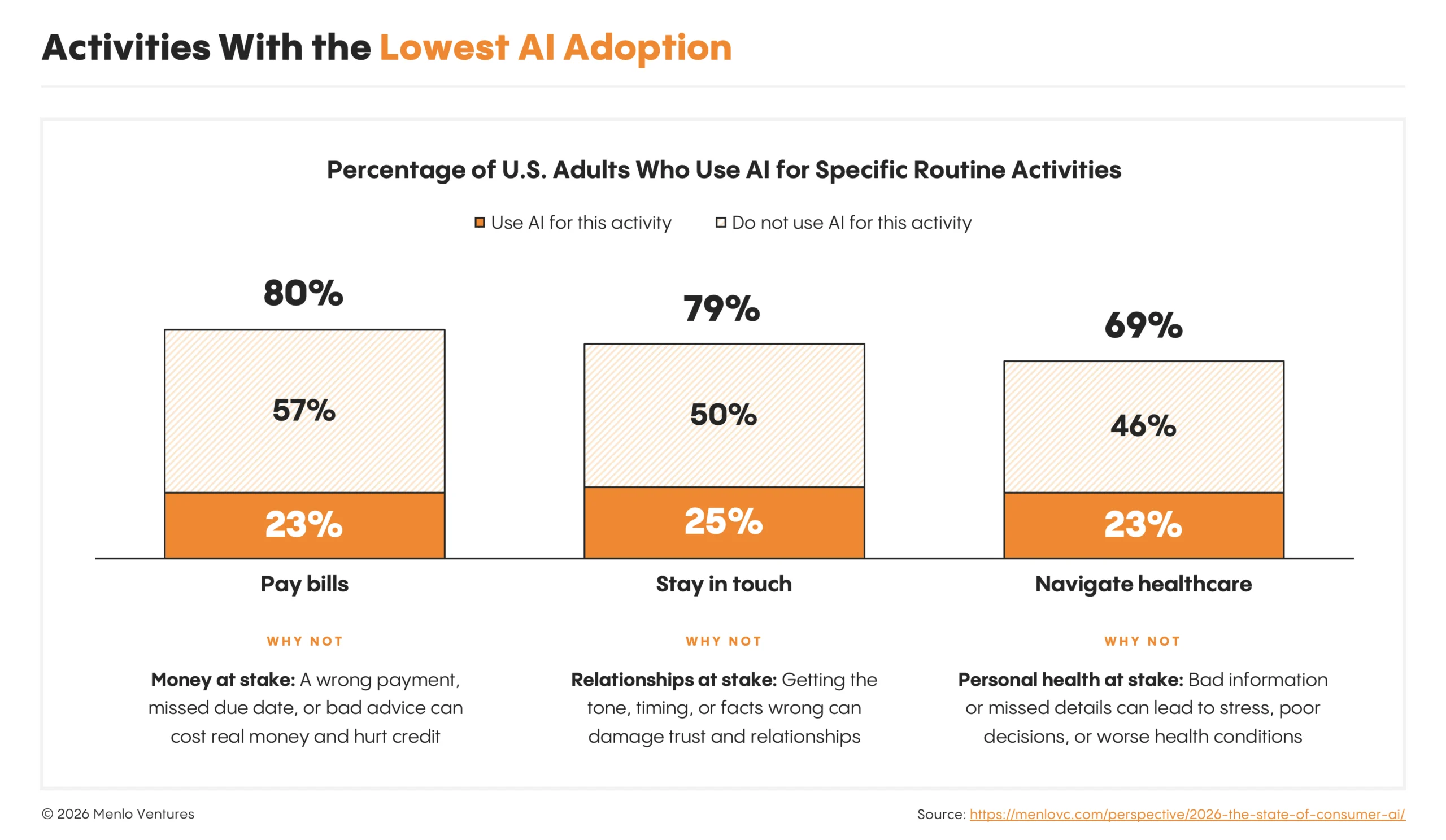
But the biggest opportunities on paper aren’t always the ones consumers want: When asked what they might use AI for next, consumers pointed to familiar territory: 43% would consider it for creating images and 40% for writing help. Paying bills and staying in touch ranked near the bottom. Among people who don’t already use AI to connect with others, half (50%) wouldn’t consider it for any related activity.
Capability isn’t the issue; AI can already summarize an insurance letter, make sense of a bill, or draft a thoughtful message. The constraint is trust. Each of these jobs touches money, institutions, personal information, or relationships—areas where getting it wrong is expensive and hard to reverse.
Healthcare shows how a category like this opens up anyway. Consumers brought AI in around the edges, researching symptoms, preparing for appointments, interpreting results—activities where the answer is easy to check and a mistake costs little. In 2025, navigating healthcare was the lowest-penetration activity in our study, at 16%. This year it grew to 23%. Consumers started where they could verify the work, then expanded from there.
For founders: Ask why adoption isn’t happening: Is the product not good enough yet, or do they simply not want AI involved? If it’s the former, there’s a market to win. If it’s the latter, start with a lower-stakes use case and earn the trust required for higher-stakes jobs.
The more consequential the job, the more trust becomes the gating factor. And nowhere is that clearer than when consumers let AI act on their behalf.
Agents: Letting AI Act on One’s Behalf
Four in 10 AI Users Have Tried AI Agents
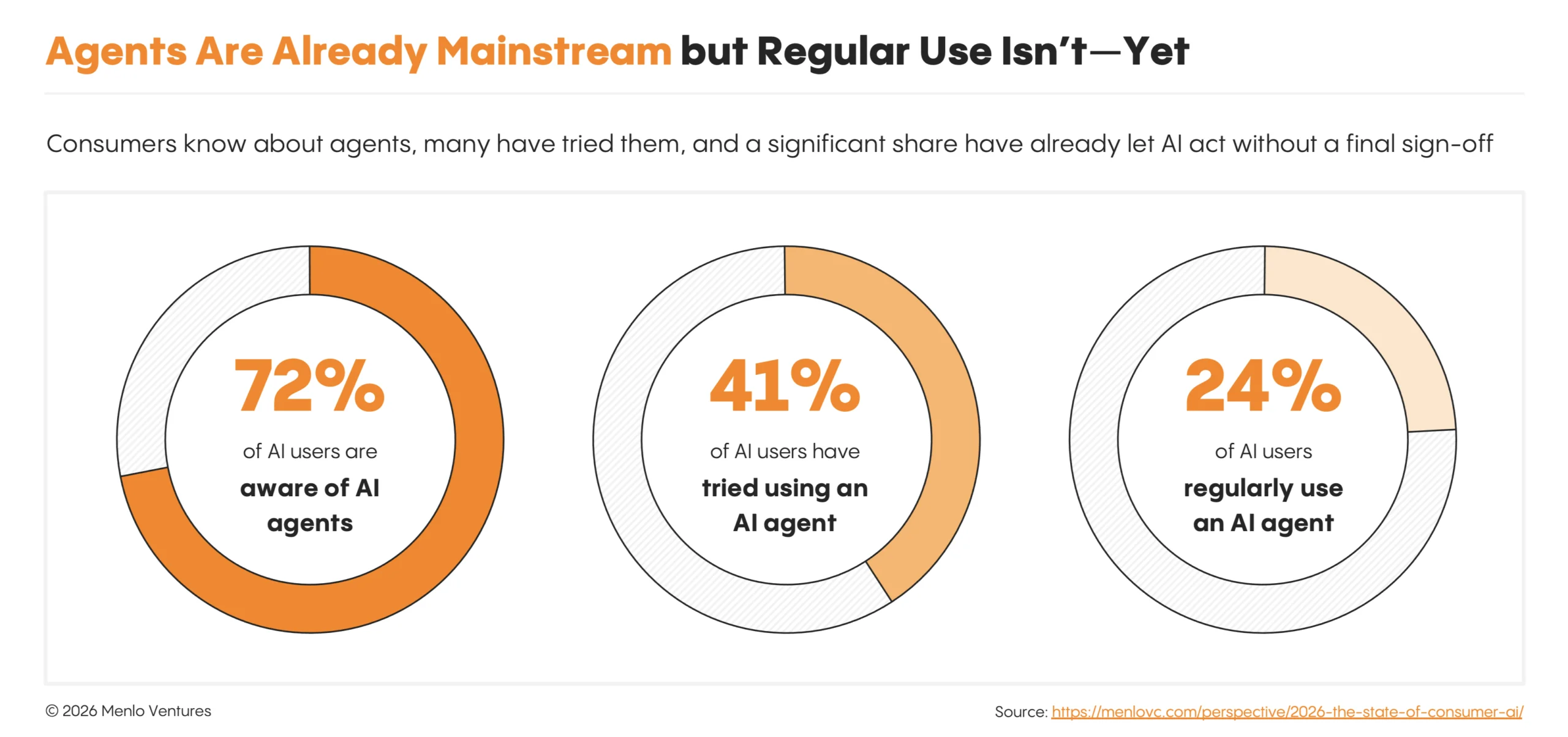
If chat was AI’s first act, this year opened the second: agents. AI agents can reason, make decisions, complete multi-step tasks, and take actions in other systems. Already, 41% of AI users have tried using an AI agent, and 24% use one regularly.
Letting AI act for you takes more trust than asking it questions; it’s interacting with your network, leveraging your resources, and representing you. Consumers who use agents are, almost by definition, AI’s most trusting and deepest users. Ninety-two percent of consumers who use agents pay for AI, compared with 55% of AI users overall. Sixty-three percent of agent users are using AI daily, versus 39% of AI users overall.
Agents need access to your apps to work, and consumers are handing them the keys. Consumers have given agents access to their email (36%), web browsers (33%), messaging apps (31%), cloud storage (29%), and calendars (27%). Granting agents access to sensitive applications, like health apps (23%) and financial accounts (20%), is far less common.
Agentic behavior is also spreading faster than many realize. Thirty-two percent of AI users have already let AI act on their behalf at least once without a final sign-off,9 whether they had AI complete a purchase, send an email, or work in a connected account; many don’t think of this as “using an agent.” Autonomy has become its own powerful measure of depth, similar to how often consumers use AI or how much they’re willing to pay for it, and people are seeking it out.
The Agent Market Is Still Wide Open
The agent market is still hotly contested. Codex leads at 35% of agent users, followed closely by Claude Code/Cowork* at 32% and Perplexity at 24%. Newer agents like Manus, OpenClaw, and Hermes* are also creeping up, each reaching 10–16%, while the new kids on the block like Town and Instinct are coming hot out of the gate.
Agent users are also among AI’s most valuable consumers. Not only do they use AI more, they are also more likely to pay (65% of payers use an agent versus just 13% of non-payers). Among people who pay for AI, 21% of regular agent users pay $100+ a month, compared to just 5% of paying non-agent users.
For now, agent use is concentrated among AI’s deepest users. But the market will reach a tipping point soon: 72% of those using AI are aware of agents;10 only 41% have tried one. Despite being as large as it is today, most of the market’s growth is yet to come.
Power Users and Holdouts: Who’s Going Deepest and Who Still Refuses?
AI’s Power Users Aren’t Just Young; They’re Busy
Technology adoption usually skews young, and AI is no exception: Gen Z still leads adoption overall at 81%, but the heaviest users are Millennials. This year, Millennials posted the largest adoption increase of any generation, nearly matching Gen Z in overall use and leading daily use at 37%, compared with 25% of Americans overall.
What distinguishes many of AI’s power users is not just age, but pressure on their time. Millennials are often juggling work, family, household logistics, and other demands, making tools that can multitask, automate routine work, or complete tasks end to end especially valuable.
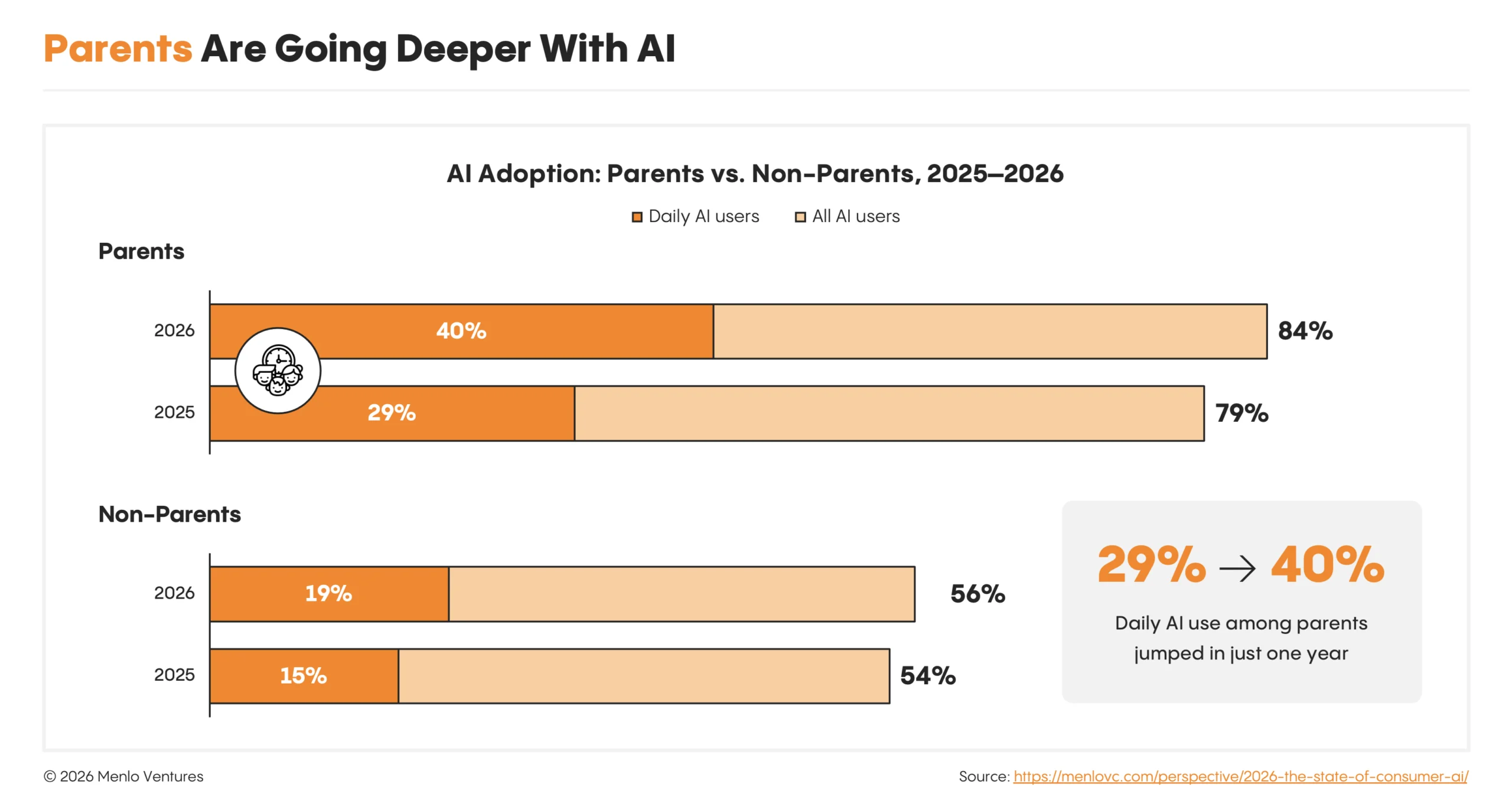
Parents are a great example. Last year, we found that parents were already AI power users, reporting nearly twice the daily usage of non-parents (29% vs. 15%). That pattern has become even more pronounced: Today, 84% of parents use AI, compared with 56% of non-parents, and daily use among parents jumped from 29% in 2025 to 40% this year. That growth isn’t just about childcare; parents are using AI across everyday life, from meal planning and paying bills to managing household logistics and other routine work.
AI Holdouts Refuse to Budge
Not everyone is going deeper with AI, and some still refuse to start. The share of people who haven’t used AI in the past six months fell modestly from 39% to 36% this year, but the holdouts who remain are digging in.11
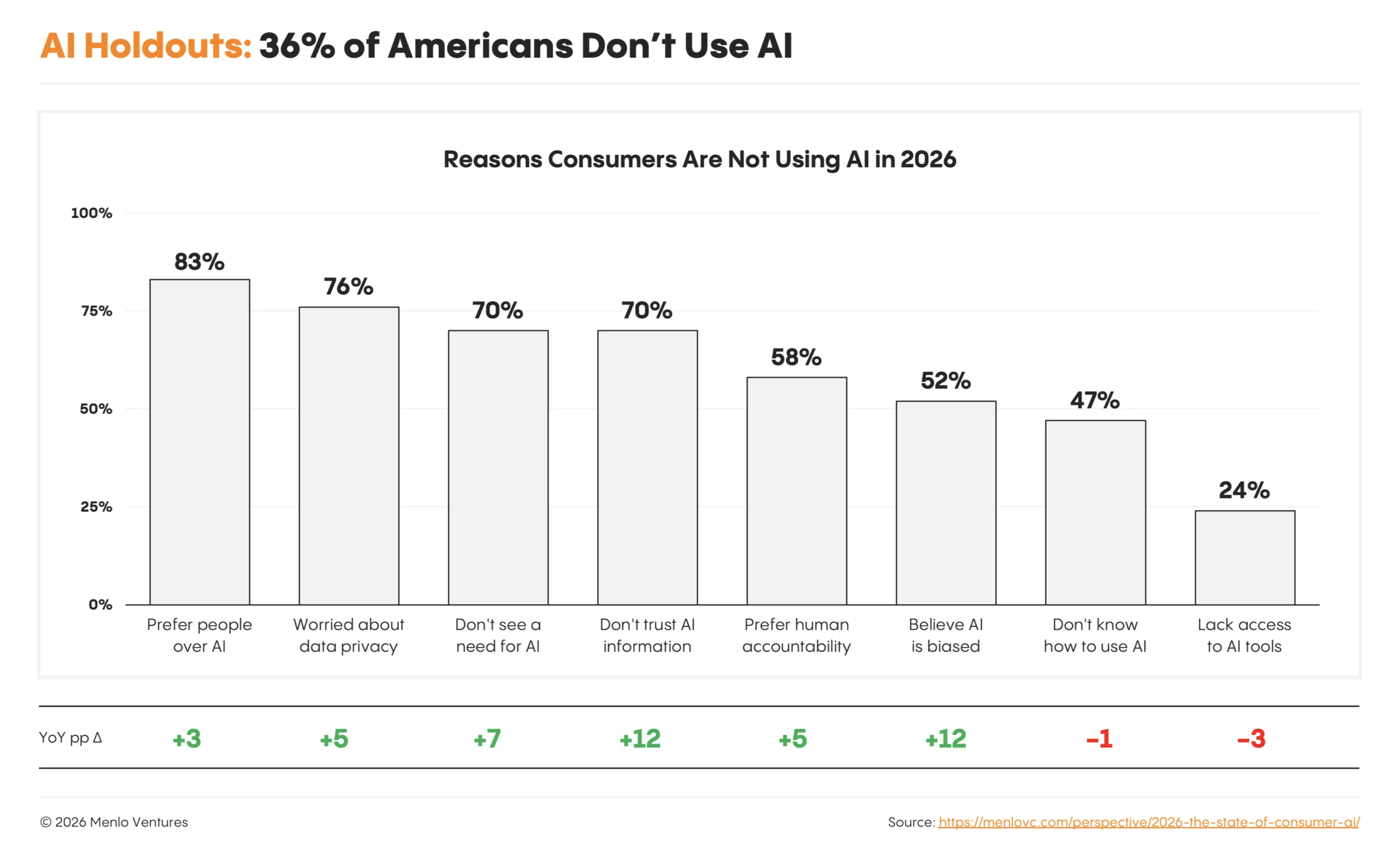
Among non-users, their objections are hardening. Seventy percent of non-users now distrust AI-generated information, up from 58% a year ago. Fifty-two percent believe AI tools are biased, 76% have privacy concerns, and 83% would rather deal with a person than talk to AI. Even the simplest objection, “I just don’t need it,” grew seven points. And on nearly every measure, the growth came from people who strongly agree.
I don’t trust the motives of the people who created it.”
—Retired man over 65 who does not use AI
I’ve tried them, and they always provide incorrect information.”
—56-year-old man, tried AI and no longer uses it
In addition, several holdouts objected for a whole new reason this year: the environment.
AI is actively destroying the environment and people’s lives, and I refuse to support a ‘tool’ whose by-product is destructive to both.”
—23-year-old woman, works in government, does not use AI
Practical excuses were less of an issue this year. Only 47% of non-adopters say they don’t know how to use AI (down one percentage point from last year), while even fewer (24%) say they lack access to it.
Evidently, AI has become a polarizing force. On one end, power users have gone all in on every dimension; on the other, holdouts are refusing to use AI more than ever. They remain unconvinced that AI is useful, trustworthy, or worth bringing into their lives at all.
Sentiment and What’s Next: How Do Consumers Feel About AI, and Where Does It Go?
Most Say AI Helps More Than It Hurts
Nearly four years in, we asked everyone—users and holdouts alike—whether AI had made their lives better or worse. Today, consumers are cautiously positive: 38% of those we surveyed say AI improved their life, nearly four times the 10% who say it made things worse. The largest group, 52%, reports no meaningful change at all.
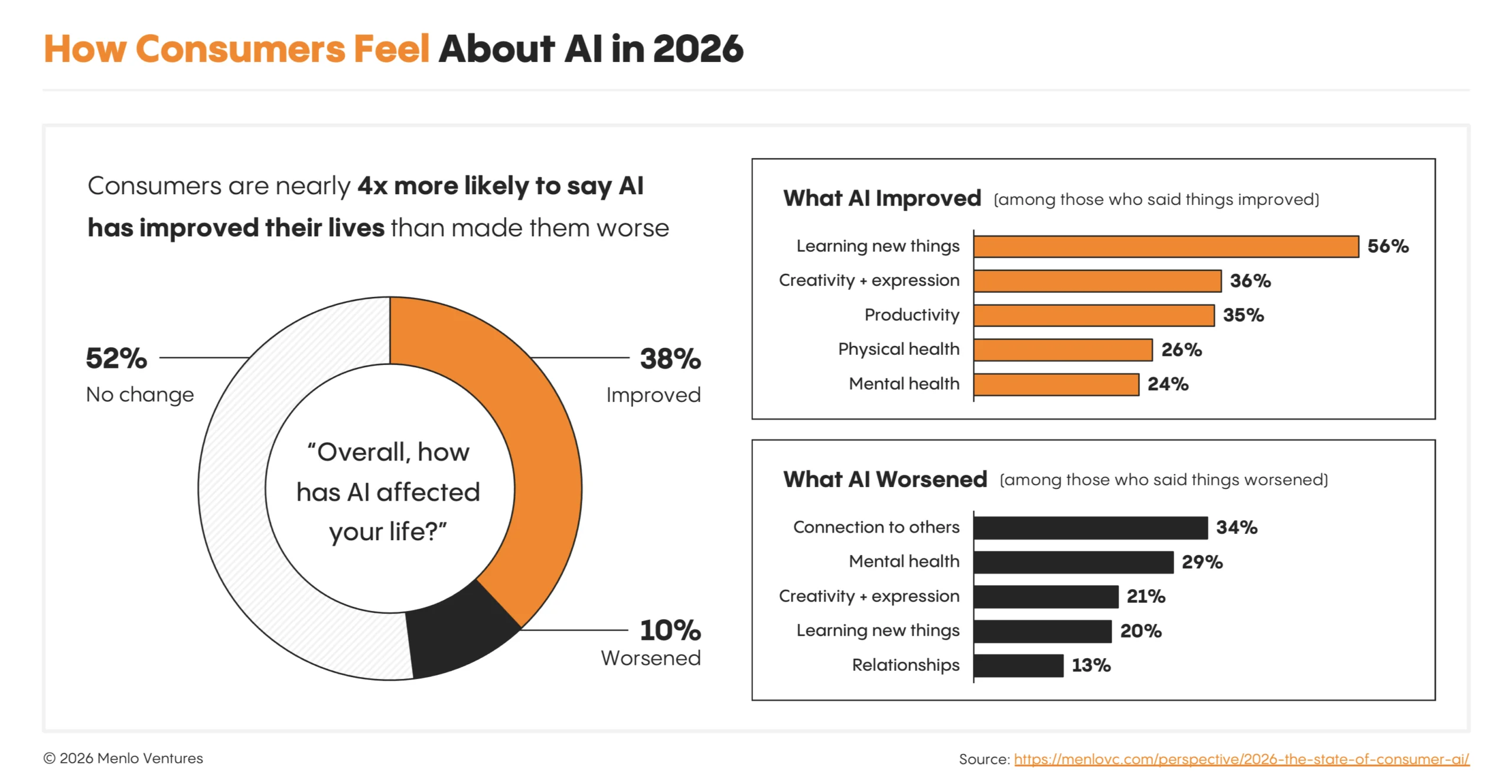
People who say AI has improved their lives point to learning new things (56%), creativity and self-expression (36%), and productivity (35%).
It’s just fun to learn, and AI puts everything right at my fingertips.”
—61-year-old woman, daily AI user
Those who say it made things worse point to their connection to other people (35%) and their mental health (29%). For the people it helped, AI made them more capable. For the people it hurts, the damage is personal: their relationships and state of mind.
It takes away human contact.”
—64-year-old man, retired, does not use AI
But the optimism around AI has limits. In all nine situations we tested, consumers preferred a human expert to AI. The gap is widest where the stakes are personal: For a medical diagnosis, 63% prefer a human to 19% for AI, and for legal advice, it’s 59% to 21%. It narrows but never closes even on AI’s home turf: For learning a new skill—the most common thing people do with AI—44% still prefer a human, versus 28% AI.
Job Security: Despite AI Optimism, Job Anxiety Persists
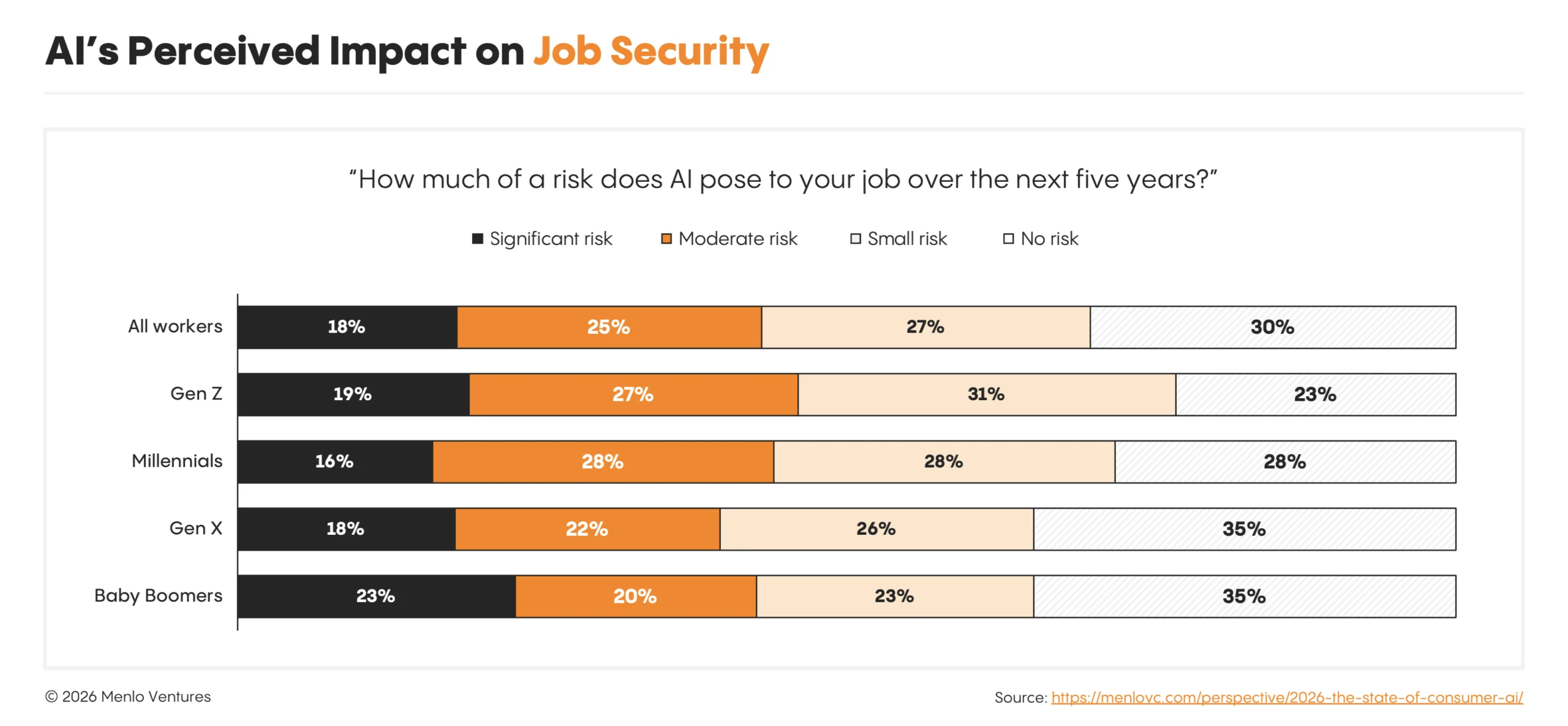
“Will AI take my job?” has been a mainstream talk track for quite some time. When we asked consumers directly, 43% of working adults see at least a moderate risk to their own job in the next five years, compared to 30% who see no risk at all. Among the generations, Gen Z feels most susceptible, with 46% of respondents feeling like there’s a moderate to significant risk to their job, and just 23% feeling no risk at all.
AI has hurt my ability to find a job—because I’ve applied to hundreds of jobs and some of them use AI to look at the applications, and the AI will just reject applications for no reason.”
—30-year-old unemployed woman who does not use AI
I lost my job due to AI.”
—54-year-old man, unemployed, does not use AI
I’m concerned about the job market or job loss. I’ve had a significant reduction of income.”
—44-year-old father of three, self-employed, uses AI every day
Consumers no longer agree on what AI is doing to their lives. Power users keep granting it more time, money, and authority, while the holdouts harden against it. In between sit the 52% who say AI hasn’t changed much for them either way. Trust already decides how deep the believers go; next, it will decide whether the market’s biggest group engages at all.
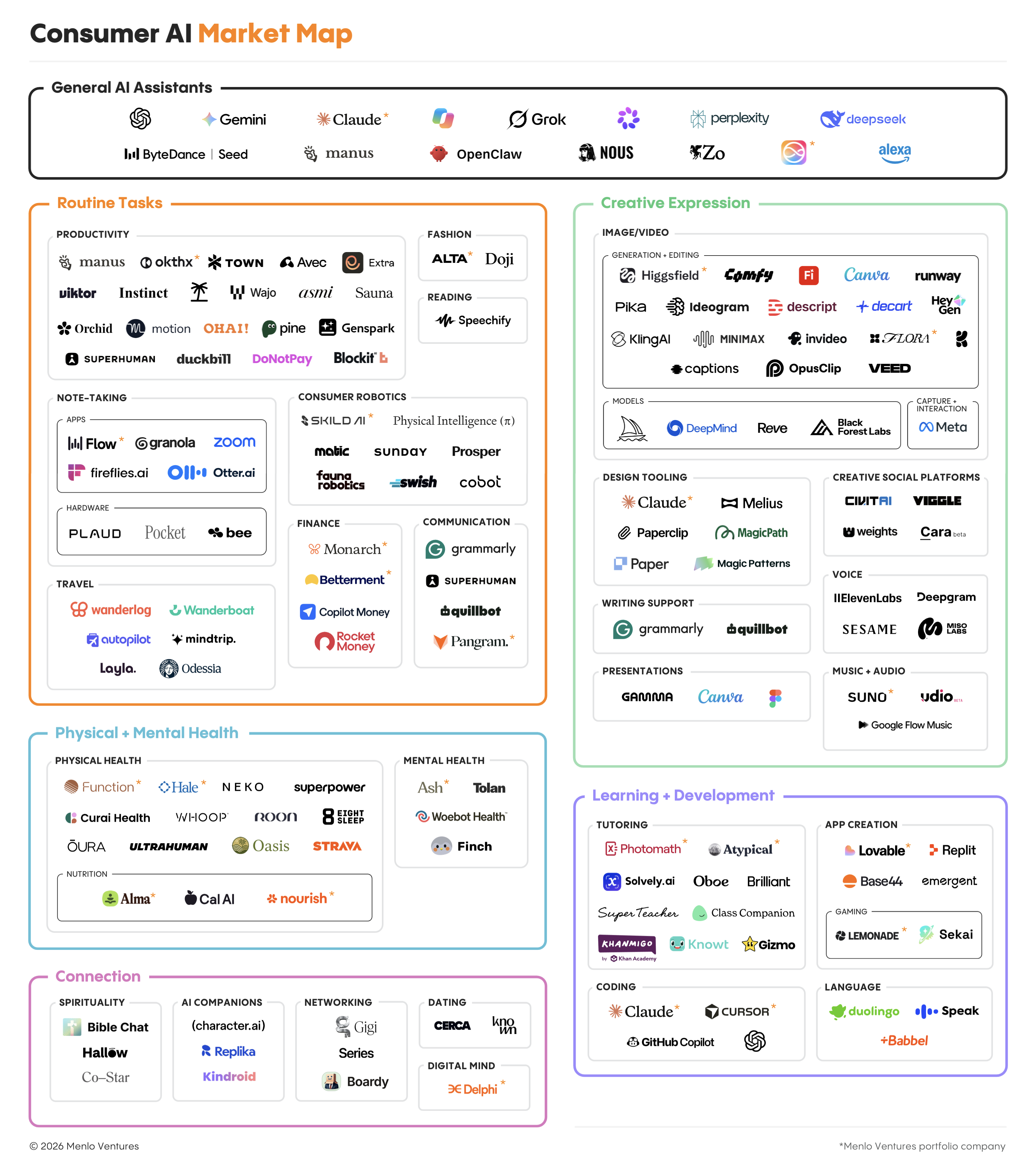
Consumer AI Market Map
The relevant competitive question is no longer simply, “What replaces ChatGPT?” A product can earn a place in the consumer AI stack by owning a workflow, solving one problem materially better, or earning access and trust that a general-purpose assistant cannot. Below are some of the companies competing across general AI assistants/agents, creative tools, productivity, learning, health, finance, connection, and emerging consumer workflows.
Five Consumer AI Predictions for 2027
1. Agentic purchases will drive $100 billion in online sales in the next 12 months.
Agentic commerce—where an AI agent influences or completes a purchase, including through agentic research and affiliate attribution—will become a core part of consumer shopping. The first categories will be commoditized products like groceries, and specialized, researched products like electronics and travel. We are already seeing consumers hand AI their credit cards, but feature gaps like security, payment dispute, and fraud detection are major obstacles to credibility today.
2. Regular agent use becomes mainstream.
Seventy-two percent of AI users know what agents are, but only 41% have tried one. We believe this gap will close: The combination of messaging integrations, long-running tasks, computer use, and growing consumer trust will make agents useful, intuitive, and trustworthy enough for mainstream adoption.
3. AI becomes a critical advertising channel.
ChatGPT launched ads in February of this year and, according to OpenAI, passed $1 billion in run-rate revenue just 200 days later. Consumers are now asking AI assistants what to buy, and brands are following them there—the same way they followed consumers to search and social media.
4. Voice moves from dictation to instruction.
Today, 46% of AI users speak to AI at least some of the time, mostly to produce text they then send themselves. Soon, spoken requests will increasingly end in a completed action or text reply, and what we say will replace both the keyboard and the text box input itself.
5. AI-powered robots will reach $500 million in sales in the next 12 months, but humanoids will lag.
Advances in AI models and falling hardware costs have pushed the price of some robots below $1,000, bringing the category into the first phase of consumer adoption. We expect early demand to center on educational toys, home security, and cleaning. Humanoid robots, however, will take longer to reach the level of usefulness, reliability, and trust required for widespread adoption in the home.
Closing Thoughts
In 2025, consumer AI was a story about reach; in 2026, it’s a story about depth. The market tripled while adoption grew three points, which means the growth came from people who were already here—using AI more often, across more of their lives, paying for it, and starting to let it act on their behalf.
Depth is harder to win than reach. Reach came from distribution: AI showed up in search results, on phones, at work. Depth is earned, one job at a time, and consumers are specific about the terms. They want AI to explain rather than answer. They’ll let it recommend a purchase before they’ll let it make one. They’ll bring it to their health questions and keep the diagnosis. Every one of those boundaries is a product opportunity for whoever earns the right to cross it.
Last year, we shared our thesis that consumers embrace tools that solve real problems better, faster, and cheaper than the alternatives. That still holds. But this year’s data adds a condition: Consumers adopt what’s useful, and they keep what they trust. The companies that will define the next phase of consumer AI are the ones that treat trust as something to be built—earned in low-stakes work, verified cheaply, and extended deliberately—rather than assumed.
If that sounds like what you’re building, we’d love to hear from you.
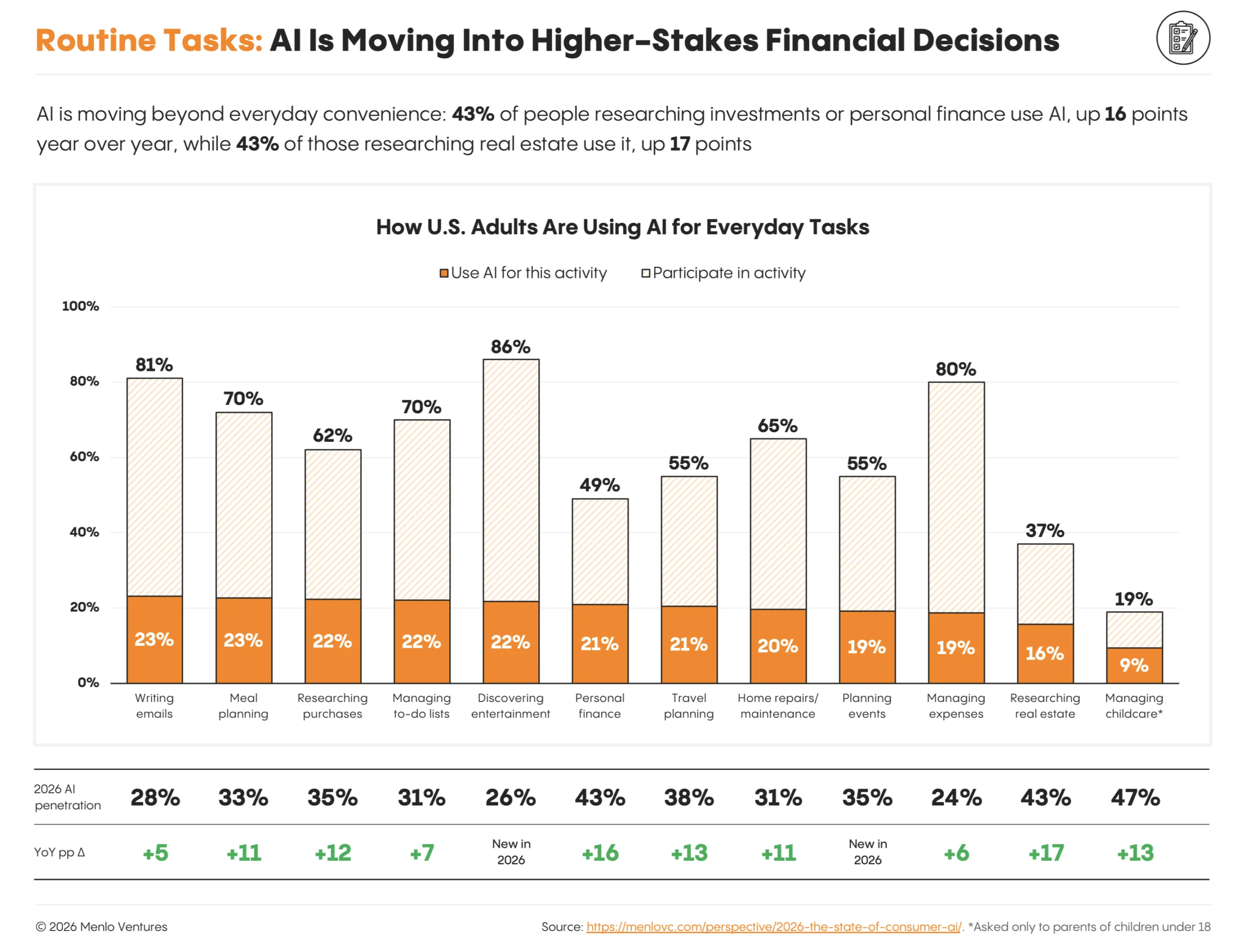
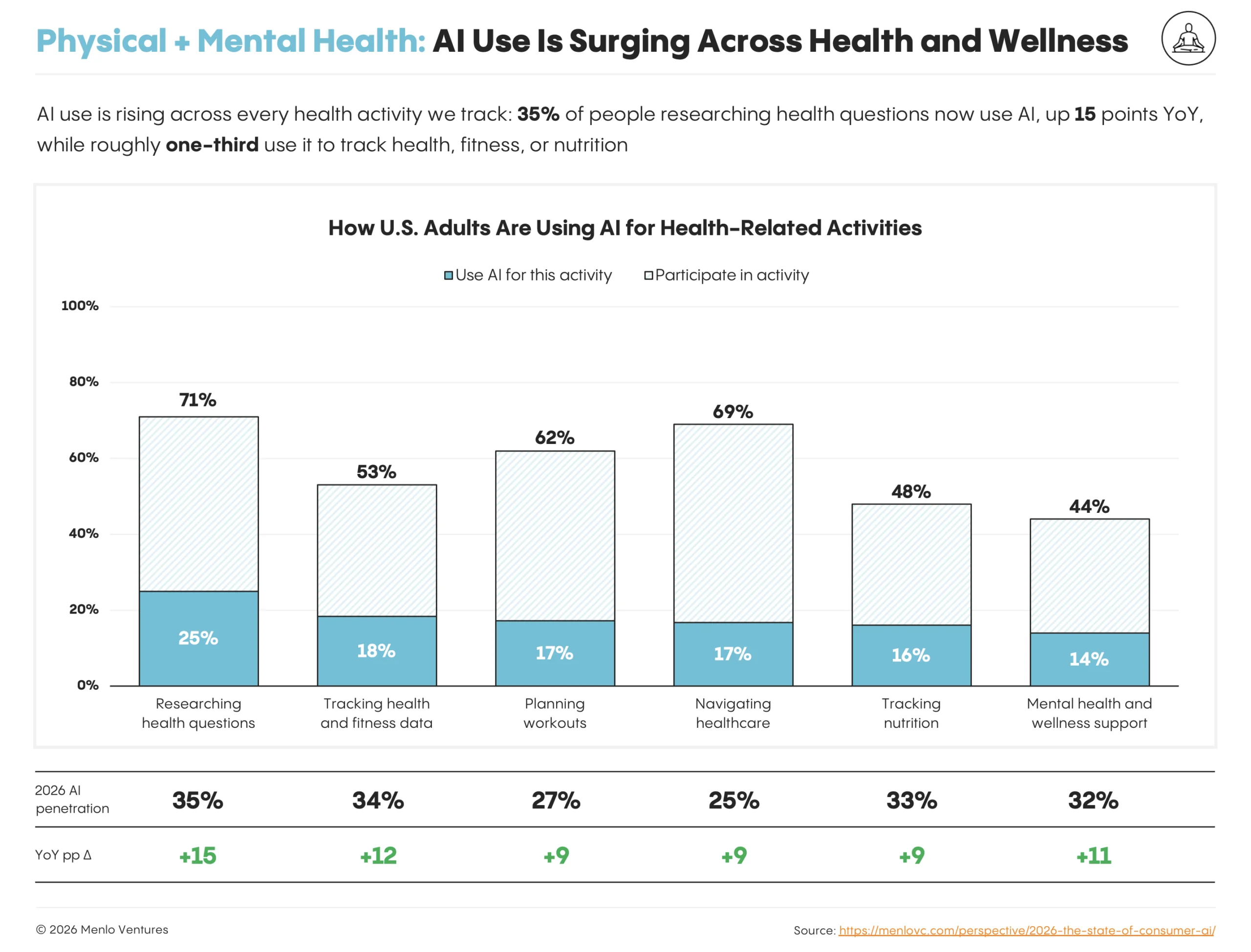
Appendix: AI Penetration by Activity
Data Sources and Methodology
Survey. Findings are based on a survey of 5,067 U.S. adults conducted with Morning Consult in July 2026. The sample is nationally representative, with weights applied for education, gender, age, race/ethnicity, and region. The survey explores how consumers have used AI and other tools to complete specific activities over the past six months, along with their attitudes toward the technology.
Year-over-year comparisons. Comparisons are drawn against our 2025 wave, which surveyed 5,031 U.S. adults in April 2025. Of the 41 activities measured this year, 37 were asked identically in 2025. The 2025 wave ran in late spring and the 2026 wave in early July, which dampens measured growth on school- and work-linked activities.
New this year. Spending, agent, interaction-mode, and sentiment questions are new in 2026 and have no 2025 baseline. Brand reach in 2025 was published as a share of all U.S. adults and has been converted to a share of AI users; chart titles state the base in each case.
Market sizing. Market size figures are Menlo Ventures estimates, anchored on survey data for AI usage and spend, and triangulated against credible third-party sources. While the survey’s usage and spending figures are reflective of U.S. adults, the global estimate is adjusted downwards to account for differences in internet access, age distribution, and regional adoption and spend rates.
How to cite this research:
Menlo Ventures, 2026: The State of Consumer AI, survey of 5,067 U.S. adults conducted with Morning Consult, July 2026. https://menlovc.com/perspective/2026-the-state-of-consumer-ai/
*Menlo Ventures portfolio company
- This figure reflects a consistent question and sampling methodology fielded identically in 2025 and 2026 among a nationally representative sample of U.S. adults, so the year-over-year comparison is apples to apples. The relatively modest top-line movement (61.0% to 63.6%) is consistent with independent third-party evidence, which also shows AI usage growth concentrated in frequency and intensity of use among existing users rather than in the size of the overall user base. ↩︎
- General AI assistants are all-purpose assistants such as ChatGPT, Gemini, Claude, Meta AI, and Microsoft Copilot, which handle any task a user brings to them, as opposed to single-purpose tools like image generators or coding assistants. ↩︎
- OpenAI’s launch of ChatGPT on November 30, 2022 is credited with sparking the modern Generative AI boom. ↩︎
- When Menlo Ventures published the first State of Consumer AI report in 2025, we estimated that roughly 3% of the world’s 1.8 billion AI users were paying for the technology. One year later, our survey suggests 55% of U.S. AI users pay for at least one tool. ↩︎
- 48% of payers pay for at least one AI tool themselves. ↩︎
- Payer sources sum to over 100%, as the question was asked as “Select all.” ↩︎
- Bankrate, July 2025, n=2,616 U.S. adults. Generational bands: Gen Z 18-28, Millennials 29-44, Gen X 45–60, Boomers 61-79. ↩︎
- Market share figures use AI users as the denominator. Last year’s report showed all adults as the denominator. ↩︎
- Includes respondents who’ve used AI to complete a shopping purchase, email workflow, and use AI agents. ↩︎
- Includes respondents who said they were unsure. ↩︎
- We classify people as AI users based on the tools they report using in our survey. There is a possibility some of the 36% are running into AI inside Google or Gmail without recognizing it. ↩︎

As an early-stage investor, Shawn focuses on companies that serve the “utilitarian consumer”—the individual seeking better, faster, and cheaper ways to move through life. Because basic human needs are persistent, he looks at how people are spending their money and time to assess the value and utility of a product…

Amy joined Menlo Ventures to co-lead the firm’s consumer practice, lead investments in application AI, and back founders building at the forefront of platform shifts. As an investor, Amy seeks founders who share her obsession with products that define how people work, live, and play. She believes that emerging technologies…

As an investor at Menlo Ventures, Sam focuses on SaaS, AI/ML, and cloud infrastructure opportunities. She is passionate about supporting strong founders with a vision to transform an industry. Sam joined Menlo from the Boston Consulting Group, where she was a core member of the firm’s Principal Investors and Private…