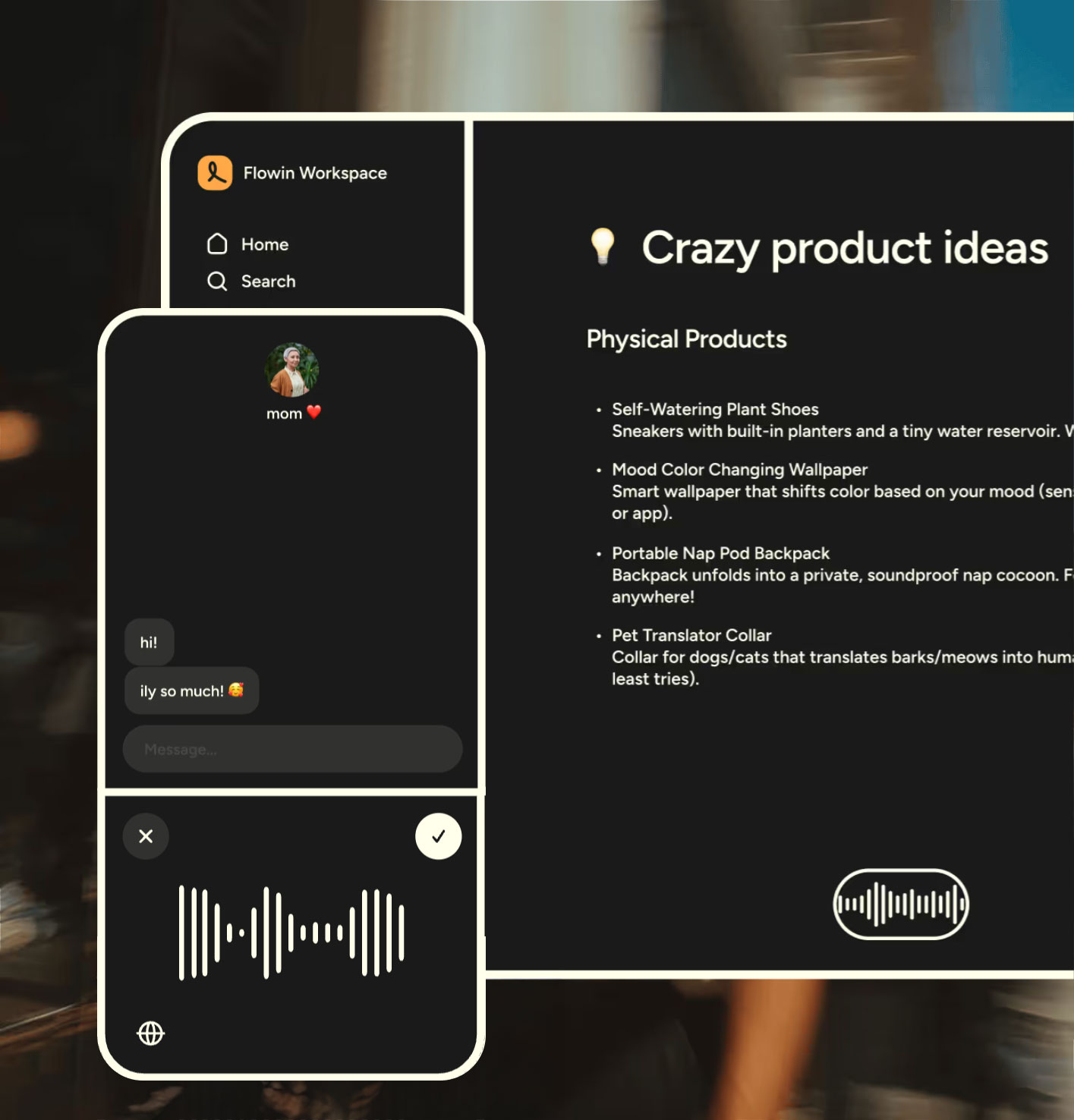


Fourteen months ago, I wrote that we were betting Wispr would kill the keyboard. The claim needed defending then; voice dictation had disappointed for decades. Since that post, Wispr has grown revenue over 30x year over year, and Flow is used in 162 countries and over 100 languages by tens of thousands of paying businesses.
The keyboard bet paid off. So today I’m excited to announce that Menlo Ventures is leading Wispr’s $280 million Series B at a $2 billion valuation and doubling down on a larger thesis: The text box is the next interface to disappear. This represents one of the largest investments we have made in an AI company.
What We Learned Watching the First Bet Play Out
The original thesis was about input. Humans speak four to five times faster than we type; we have been waiting for our thumbs to catch up with our thoughts. That was right, and it was incomplete.
The frontier labs have produced superhuman AI intelligences. They have not produced delightful and effective human interfaces: how a normal person, outside the (somewhat) prompt-literate bubble of Silicon Valley, conveys intent to that intelligence. Today, the answer is a text box, and a text box is a tax on thought and productivity. The bottleneck in AI has moved from the model to the interface. Wispr is the interface.
The strongest objection, the one I would make myself on the other side of this deal, is that dictation is a feature. Two things break that argument. “Free and mostly right” loses to “zero edits, everywhere” for anyone who talks for a living. And executing what you meant, rather than transcribing what you said, takes context no OS checkbox has. Free dictation has been everywhere for a decade and used by almost no one: a feature can transcribe, but acting takes a company.
Digital Thought, Not Speech Recognition
The clearest signal of where this goes is who just joined to build it. In July, Wispr launched the Advanced Interfaces Lab, led by Ariya Rastrow as Chief Scientist. Ariya helped build voice AI’s first mainstream moment, then spent a decade learning why its utility stalled at weather, music, and timers. His diagnosis matches ours: The last generation failed on intelligence, and now that intelligence has arrived, the speech-to-text-to-model pipeline everyone still uses is the wrong architecture for what comes next.
The Lab exists to replace it with voice-to-outcome: Systems that understand intent in the full context of your digital world and respond with an action, a workflow, or an interface built for the moment, rather than a chatbot’s paragraph. Not speech recognition. A channel for digital thought, the shortest path from what you mean to what happens. Engineers steer coding agents by voice, because typing prompts to a system that types faster than you is a bottleneck. Sales reps talk through a call and the CRM updates itself.
Why Double Down Now
The signal I trust most is when customers pull a product somewhere the roadmap wasn’t yet purpose built to reach. That is Wispr today, in both directions at once: consumers pulling Flow into new countries and languages, and enterprises pulling it from personal dictation into whole-team and whole company deployments without any scaled sales motion.
This round funds both halves of that pull. Scaling the sales team, the enterprise product, and the country expansion is how voice becomes part of every company, and it compounds: Every organic user is the future pipeline, every deployed team is a reference. The Lab builds the next generation interface layer those same companies graduate into.
The part I’m still turning over is how far the thesis runs. Voice is the first modality where intent outruns the interface, but it won’t be the last; the Lab’s charter extends to what you see, think, and what you’re working on, not just what you say. Whether it ends somewhere as large as I suspect is the kind of question you only answer by building. We are extremely excited to continue to make this bet and build with Wispr.
Wispr is hiring for many roles including AEs and RSMs for the enterprise team and researchers for the Advanced Interfaces Lab.

Matt Kraning is a partner at Menlo Ventures focused on AI, national defense, robotics, and cybersecurity. Before joining Menlo, he co-founded and served as CTO of Expanse, a category-creating data and cybersecurity company that Palo Alto Networks acquired for $1.25 billion. At Palo Alto Networks, he oversaw generative AI development…