

Electronic messaging is the “API” between humans. The same way computers invoke APIs to get a server to take action, we humans send each other e-instructions. Read X, do Y, learn about Z; messaging holds the throne for the most important source of information determining the actions of knowledge workers. But for many workers, triaging, parsing, and prioritizing action from the e-morass has become a second job they hold in disdain. The numbers are hard to ignore: Knowledge workers spend more than 13 hours a week—over a third of the workweek—on email, chat, and text alone, and nearly half the week on written communication overall.1 When so much of the workweek runs through messaging, the opportunity to rethink it becomes obvious.
Enter the large language model (LLM)—purpose-built to ingest written instructions, make sense of them in context, and act. Today’s LLMs can now do much more than make messaging a little more efficient. They can triage what matters, route messages, draft with context, and hand off work across systems. The models already do the hard parts; now, smart entrepreneurs need to tackle the reinvention to define what messaging + LLMs equals.
The Market Is Huge
The first major wave of machine learning in the inbox focused on filtering out spam and security threats. Even with that relatively narrow scope, the outcomes were meaningful: IronPort* was acquired by Cisco for $830M, Postini by Google for $625M, MessageLabs by Symantec for $695M. Those that held on to their independence longer were acquired by private equity for even larger outcomes: Proofpoint by Thoma Bravo for $12.3B; Mimecast by Permira for $5.8B.
That value came from filtering out noise. With LLMs, the opportunity is much larger: helping workers become more productive in the tools where work already happens.
Integration + Automation Segment the Landscape
We map the emerging market on two dimensions: integration approach and autonomy level.
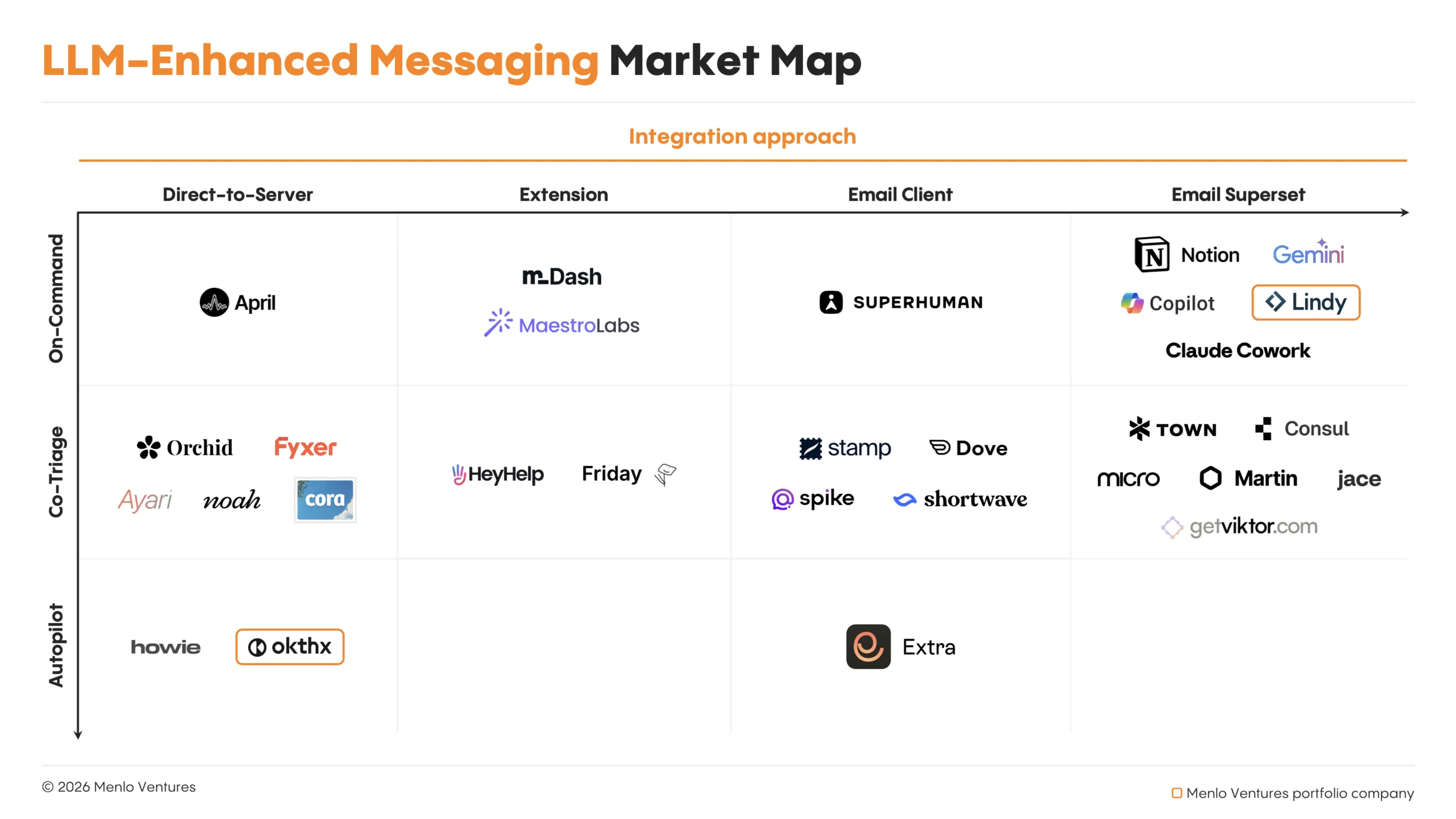
We see the emerging market breaking along two dimensions: where the product sits, and how much work it handles on its own by default.
The first question is integration. Direct-to-server products communicate directly with the email server, labeling emails, and drafting replies with a web interface for configuration. Extensions install into browsers, overlaying intelligence and tools on top of the web interfaces people already use. Email clients rebuild the client itself, which gives more control but asks users to switch away from Gmail or Outlook. And finally, email supersets include the email inbox as only one element of a broader platform, connecting also with systems like CRM, calendar, and project management.
The second question is autonomy. On-command products act only when prompted. This includes both one-time and recurring actions that are manually configured. The co-triage approach has a number of methods implemented out of the box, some triage, drafting, labeling, while keeping the user in the loop. The most aggressive approach is autopilot, handling many messages on their own and surfacing what happened after the fact.
Myriad Design Choices
No single approach will win every user; email behavior varies too much. But beneath all the variation, every winning product will need to get a few things right, as well as make hard design choices on behalf of its ideal customer profile.
Trust and security are table stakes. Messages are among the most sensitive data in any organization. Any breach or perception of irresponsible use will end the sales conversation.
Simplicity and speed are critical. These products live inside workflows people use all day, so the interface has to feel effortless: clean enough that a new user is productive in minutes, not hours, and fast enough that the assistant never feels like another layer of work. As Superhuman proved, interface latency matters. The 100-millisecond rule still applies. Given today’s time-to-token constraints, smart UX can make or break the experience.
How opinionated is it out of the box? There’s a delicate balance between imposing an opinion and allowing configurability. Some products will arrive with predefined best practices. Others will learn through collaboration over time. The most ambitious may mine past behavior to personalize deeply without asking much from the user upfront. The first-time-user experience will matter as much as capability. Users are unlikely to trust broad automation before they have seen the product make good decisions in narrow, repeated ways.
How much behavior change is required? The tools asking the least of users reach the most of them. At one end, server-level integrations require zero behavior change; at the other, full alternative clients demand you abandon Gmail or Outlook entirely. More product surface unlocks more capability, but habits are durable, and switching costs are real. The winners will find ways to earn deeper adoption over time, not demand it upfront.
What never needs to reach the user? The highest-value action is the one the user never had to take: the message autonomously handled, the task automatically logged, the response sent without review. Getting users comfortable with that level of delegation is the real product challenge.
What message sources can and should be consolidated? If messages across email, iMessage, WhatsApp, LinkedIn, Facebook, Slack, etc. are all just grabs for your attention, shouldn’t they all be triaged by the same algorithm? There have been multiple attempts over the years to consolidate message streams in one place. None have gained much market share, primarily because the UX isn’t quite perfect for any of the underlying messaging mediums. Perhaps the arrival of agents, especially those that sit on a desktop and intercept hard-to-integrate-with platforms, means the time has come.
None of the above matters if outputs aren’t reliable. In a category built on delegation, a single unexpected action, whether a hallucinated response sent or a task misrouted, erodes the trust that the whole product depends on.
The end state isn’t a smarter inbox. It’s a dance between human and machine to surface the insights the human needs to be effective, while surfacing issues that warrant human judgment with context already gathered, routine work handled, and next steps a click away.
The Wildcard
A haunting question is whether this whole category will fall victim to “marketing myopia,” as postulated by Theodore Levitt: Railroads defined themselves by the medium (rail), rather than the job (transportation), and missed the plane.
So many of the past inbox reinventors made the same mistake: optimizing the container instead of asking what coordination via messaging actually needs.
Email is ancient, with the first transmission in 1971 (before I was born)! Every major communication shift since made email irrelevant for specific jobs by abandoning the format entirely. Social media, Slack, Zoom, SMS, WhatsApp—none made email better; they just removed a portion of the messages.
That said, email is still the default way to get the attention of someone you don’t know yet. Its utility has led it to be a to-do list populated by other people, which, for many jobs, is still indispensable. So what happens when LLMs can complete many of our tasks and agent-to-agent communication is the norm? The inbox was built for people talking to people. What’s coming may be a mix shift by volume: 1) agents talking to agents, 2) agents talking to people, and 3) people talking to people. What are the implications?
We’re actively looking for teams rethinking messaging as a core workflow layer. If that’s you, we’d love to connect.
*Menlo Ventures portfolio company
- Grammarly and The Harris Poll, The State of Business Communication 2024, https://www.grammarly.com/business/learn/introducing-2024-state-of-business-communication/. ↩︎

As an early-stage investor, Shawn focuses on companies that serve the “utilitarian consumer”—the individual seeking better, faster, and cheaper ways to move through life. Because basic human needs are persistent, he looks at how people are spending their money and time to assess the value and utility of a product…

As a Principal on Menlo's Inception team, Ryan spends her time working with and investing in founders at the earliest stages. Her focus is AI-native businesses solving real, venture-scale problems. She offers hands-on support to help founders pressure-test concepts, sharpen their wedge, and translate broad ambitions into focused, fundable businesses.…