

Startups globally raised $297 billion in Q1 2026—the highest quarterly total ever recorded, according to Crunchbase data reported by TechCrunch. That’s a 2.5x increase over the prior quarter, outpacing every full year of global VC activity before 2019.
The market is back, and startups are raising big rounds again. But for many of those startups, raising isn’t the hard part; hiring is.
That might seem counterintuitive, but we can explain: While a high valuation signals momentum to the market, it changes how candidates evaluate you. They look harder at the math. They question the upside. They run the numbers and wonder how much bigger you can realistically get. A $300M valuation is an easy sell. $3B requires a different conversation.
It doesn’t cost you the candidate. But it can cost you time, and often, the best candidates won’t wait.
The founders who get ahead of this, turn a strong fundraise into real hiring momentum. The ones who don’t end up wondering why closing great people suddenly feels harder—right after raising the round that was supposed to make it easier. We’ve seen both play out, and the difference usually comes down to how prepared they were for how the conversation will change.
Top Talent Runs the Numbers
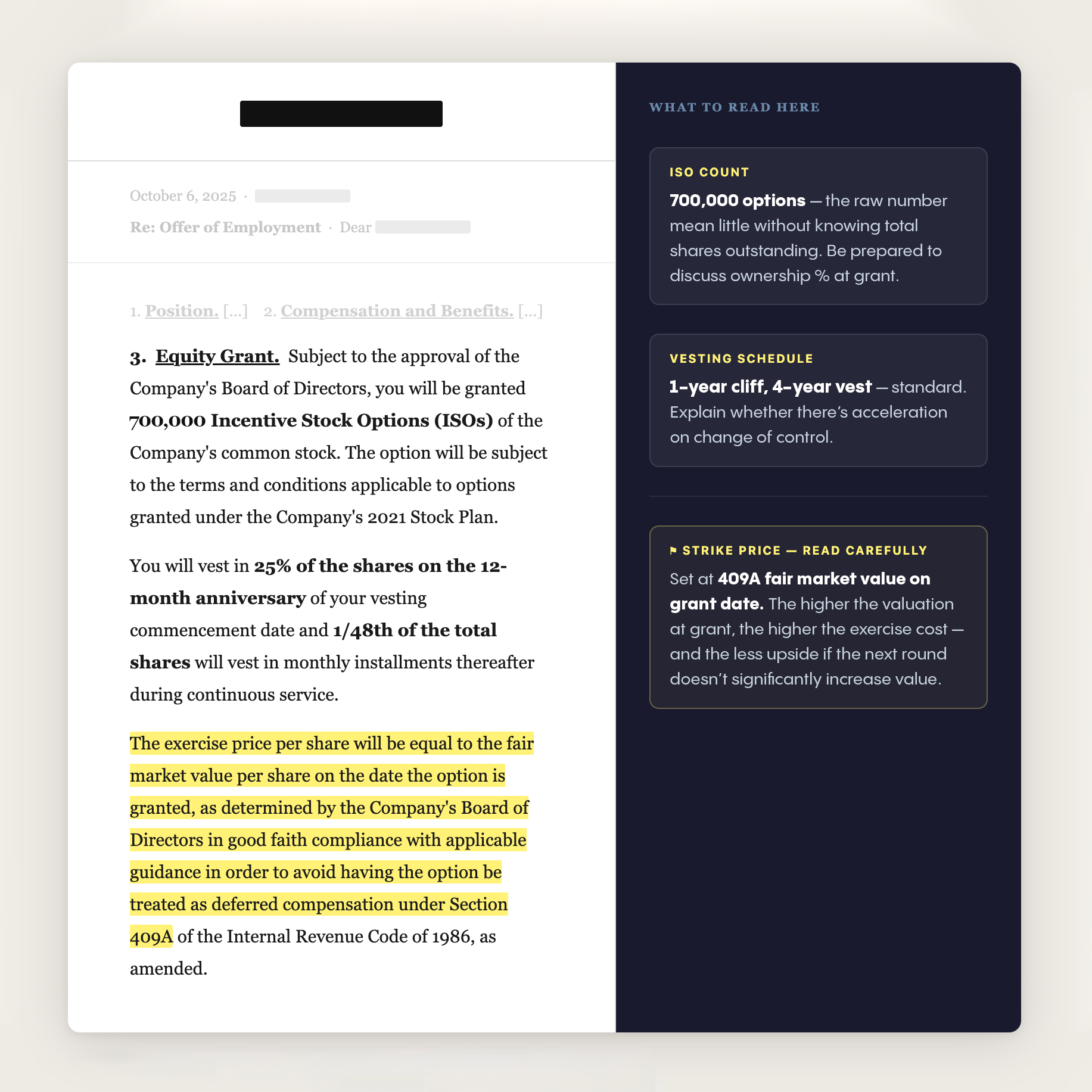
Highly sought-after candidates, especially experienced operators and executives, are sophisticated in how they evaluate compensation. When they see a high valuation, the first thing they ask is: “What is the equity actually worth given where you’re priced today?” Stock options are granted at a strike price—the fixed price at which employees can purchase shares—set at or near your 409A valuation (an independent appraisal of your company’s fair market value). The higher your valuation, the higher their cost for ownership in the company. And when they exit, they only pocket the difference between that strike price and the exit price. The math is simple, and they will do it.
- Strike price directly affects upside. If your company raises at a $300M valuation while a competitor raises at $100M, new hires at your company lock in at a much higher strike price. If both companies exit at the same valuation, your employee earns considerably less. Candidates understand this and will run the numbers before you ever make an offer.
- Elite talent wants to feel early, not late. They are looking for companies where their equity can compound 10x, 20x, or more. When a valuation appears elevated relative to traction, candidates wonder whether the most significant growth has already been priced in. That perception, even if unfounded, can push a candidate towards a competitor.
- Down round risk is part of the calculus. If subsequent growth doesn’t keep pace with an aggressive valuation, a down round can render options underwater. The strike price exceeds the share value and the equity becomes effectively worthless. Candidates who have lived through this once factor that risk into every decision.
That’s why, when the equity story feels less compelling, candidates often look for ways to offset that risk, whether through higher cash compensation, larger equity grants, refreshers, or, in some executive cases, a longer post-termination exercise period.
The Exception: AI Infra and Research-Heavy Companies
As we work with teams across Menlo Ventures’ portfolio, we’ve seen a meaningful exception to this phenomenon emerge among AI infrastructure companies competing for elite AI and research talent. At that level of the market, a high valuation often works in your favor.
Top researchers and AI scientists often have one primary concern: Can this company actually support the work I want to do? They need resources, compute, and organizational credibility, and a strong valuation signals that you have all three. A high valuation signals exactly what they need to hear: This is a place with the resources and backing to do the work at the highest level.
This is a recent shift, and it’s not universal. It applies most clearly to companies building at the infrastructure or foundational model layer, competing for candidates who are choosing between you and a frontier lab. For most startups, the dynamics below still apply.
How Founders Get the Hire
None of this means raising high is the wrong move. But as valuations climb, the recruiting conversation changes, and your approach needs to evolve.
Lead with Mission, Not Just the Round
In a competitive market, the best talent has their pick of strong opportunities—each with credible upside, real momentum, and a team worth betting on. These candidates aren’t optimizing purely for financial return; they’re looking for genuine ownership, hard technical problems, and the chance to work on something that actually matters. That means you’re not just presenting a package; you’re competing for attention. And in that fight, your mission has to be as sharp and tangible as your business case.
Be Transparent About Equity Structure
Top candidates will do their diligence. They’ll ask detailed questions about your cap table and your valuation rationale. Come prepared. Founders who lead that conversation, clear-eyed on the options and honest about the tradeoffs, build credibility fast. Those who fumble, avoid, or deflect quickly lose the candidate’s confidence and, with it, the candidate.
Know your numbers before you extend an offer. Share a detailed option package, walk them through the math, and point them to tools like Carta’s Startup Equity Calculator so they can model different exit scenarios themselves and draw their own conclusions. The goal isn’t to sell the equity. It’s to make sure they understand it.
Assess Whether Your Offer Is Structurally Competitive
In a market where valuations are elevated across the board, some companies compensate for higher strike prices through larger option grants, stronger base salaries, or accelerated vesting schedules. Before making senior offers, pressure-test them against what comparable companies are offering, not just in total compensation, but in realistic equity upside. At Menlo, we do this work alongside our founders. It’s worth the time. In our experience, losing a key hire costs far more than closing a compensation gap early.

Sharpen Your Narrative
The same discipline that makes for a strong investor pitch makes for strong recruiting. Can you explain your differentiation in two sentences? Does your market framing make the opportunity feel inevitable? Candidates evaluating multiple offers are making bets on trajectory, and the founders who can make that trajectory feel clear, credible, and inevitable are the ones who win the candidates everyone else is chasing. They have the conversation directly with candidates—they don’t outsource it.
Ultimately, top candidates are drawn not just to the vision, but to the leaders behind it. Are the founders credible, compelling, and magnetic enough that exceptional people want to follow them, learn from them, and stay for the journey?
The Bottom Line
Highly sought-after talent is acutely aware that saying yes to one opportunity means closing the door on others. That creates a different kind of pressure: not just finding the best option, but avoiding the wrong one. The opportunity cost compounds over years, and they know it. So the real question isn’t, “Is this a good opportunity?” It’s, “Is this worth the risk?” The founders who compel a great candidate to say yes aren’t always the ones with the highest valuations. They’re the ones who treat the conversation with the same seriousness the candidate does.
If you’re a founder reading this, we hope it’s useful. If you’re the candidate it describes, we’d love to introduce you to a few companies worth a serious look.

Jordan leads talent strategy at Menlo Ventures. He is responsible for building the firm’s network of next-generation entrepreneurs, executives, and locks arms with founders on their team-building journey. Jordan has spent the past 20 years coaching CEOs and founders on how to build world-class management teams and boards. Prior to…

With over a decade of executive placement experience, Kandace has been dubbed a “ninja of recruiting” by her peers. As Vice President of GTM Talent at Menlo, she spends her time cultivating relationships with top sales and marketing executives across Menlo’s focus areas, concentrating on AI, infrastructure, and cybersecurity. She…