

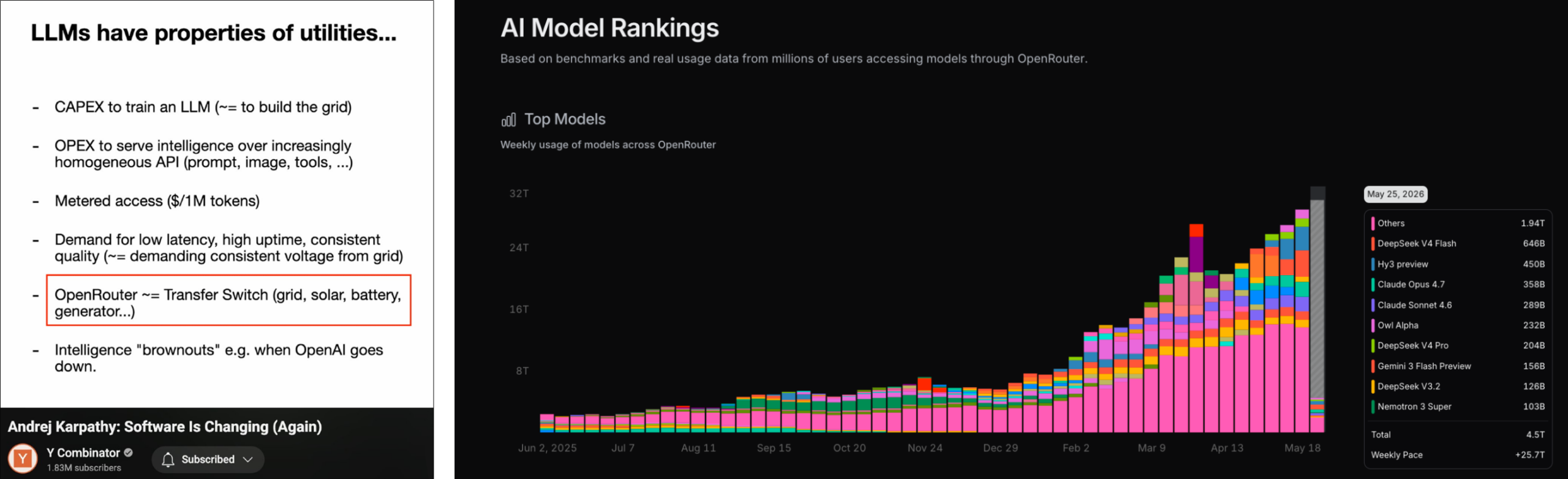
AI is becoming a multi-model world, and OpenRouter is the core infrastructure that allows you to leverage that, whether it’s a developer’s $5 side project or a trillion-dollar business. To quote Andrej Karpathy, OpenRouter is quickly becoming the de facto “transfer switch” of AI today.
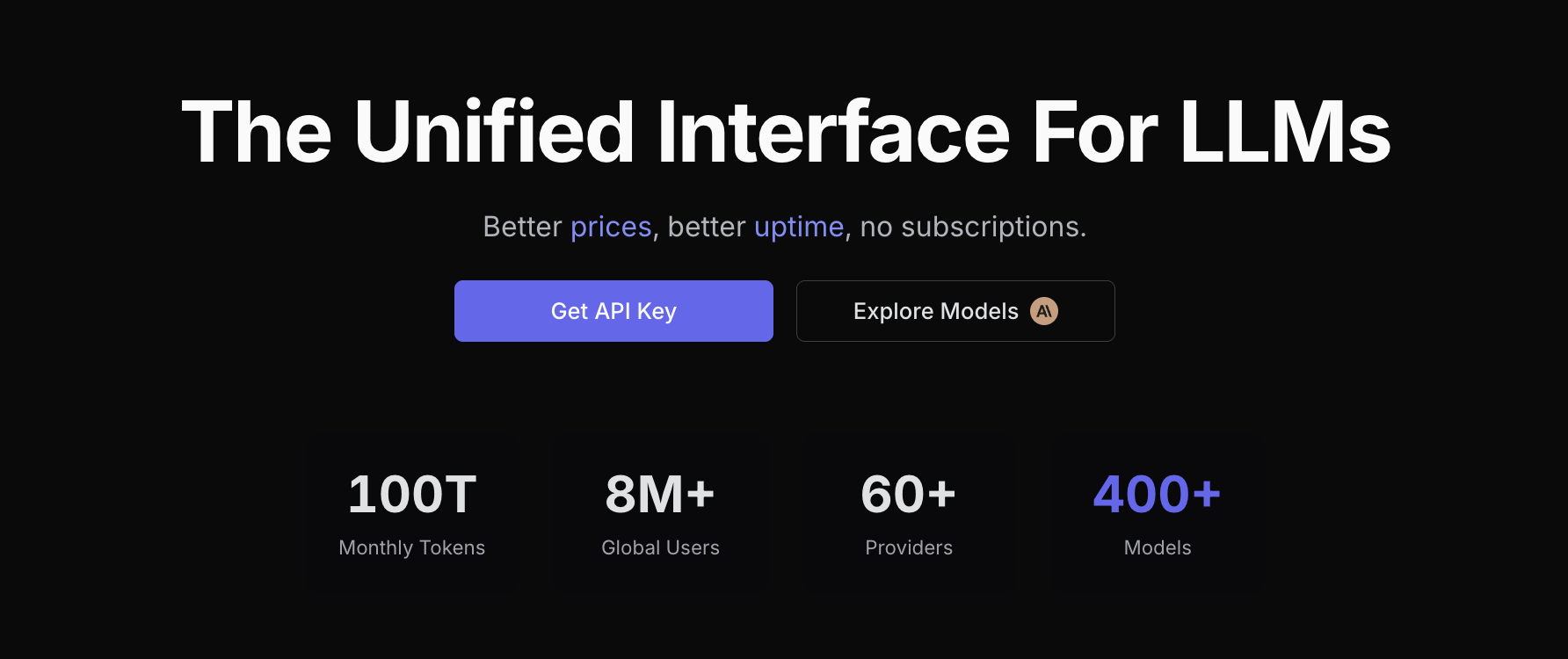
When we announced our $40M investment in OpenRouter almost exactly one year ago, they had 2.5M+ developers and had just crossed a ~100 trillion tokens/year run rate. Today, they are at 8M+ developers and, as of this week, will be at a ~1.5 quadrillion tokens/year run rate. That’s one followed by 15 zeros. For comparison, that’s ~15-30% of all of Google’s token run rate, 20-40% of OpenAI’s run rate, and likely >50% of Azure Foundry. On the back of this growth, they’ve raised a $113M Series B at a $1.3B valuation led by CapitalG. Their revenue has already doubled since the round was done in February.
What is OpenRouter?
OpenRouter helps developers and organizations access, route, and choose inference across 400+ AI models through one unified interface.
Why use OpenRouter?
The pace of AI model releases is frenetic, with often multiple models coming out every week. Most enterprises and developers, for simplicity, just stick to the one or two models from providers they know. And they’re leaving a lot on the table. With OpenRouter, you get:
- Different models that are good for different things. You might not always want to use the best, most expensive model if you’re running a batch job to parse entities out of a document. Different tasks require a different cost/quality/latency. You don’t need a Ferrari to drive you around New York City!
- That the same model on different providers is different. Initially, one might think (like I thought) that, if I’m using a given popular open-source model, say Kimi K2, that at least I can expect quality across different providers, but it turns out that is not the case! OpenRouter lets you see the same model stacks up across different providers—on latency, throughput, uptime, price, context length, and quality.
- The best uptime for any given model. Many businesses and products rely on uptime, but often, many LLMs don’t even give you one nine of reliability. OpenRouter lets you fall back to one of the, say, five providers serving a model, greatly increasing the number of nines of uptime you can expect from a model.
- Convenience. Every model has its own sign-in page, its own billing, its own way to get and cycle API keys. Why deal with all of that hassle? OpenRouter gives you all the models in one API. Not all models have the same support for things like tool calling, guardrails, caching, and, importantly for many enterprises, zero-day retention of data. With OpenRouter, you have them all.
- A solution built for enterprises. In the last year, OpenRouter has been hard at work building for enterprises. Businesses want their employees to have access to different models. But how do you do manage spend organizationally? How do you set policies? What if I have my own capacity already? Can I ensure my data isn’t logged? With OpenRouter Enterprise, you can introduceAI to your org while being completely in control.
Why should I work for OpenRouter?
OpenRouter is a lean team of ~50 people. That’s over 20 trillion tokens per year per employee and ~$2M in net revenue per employee. This isn’t the founders’ first rodeo either: Alex Atallah is a 3x founder who previously started the $13B NFT company OpenSea, and COO Chris Clark is a 2x former founder of a public company. The team is remote-friendly with a cluster of employees in NYC and prioritizes startup experience over pedigree, with most of its engineers coming from places where they’ve actually built things from 0 to 1. Compared to many startups, OpenRouter is actually quite fairly valued, especially given the velocity of its growth since the last round already. They’re positioned so squarely in the middle of the AI stack that there’s a lot of headroom to grow in many different directions.
What’s next for OpenRouter?
The main things that OpenRouter has been working on in the last year are:
- Going beyond text models. Going multimodal. You can now get image, audio (speech and transcription), embedding, and video models on OR. This area continues to be something the team is working on in the coming year.
- Going enterprise. Businesses are overspending on AI, and companies like Uber and Microsoft are blowing through their token budgets. OpenRouter Enterprise allows you to bring all models to the enterprise, set spend management rules, and allow your employees to use cheaper models for easier tasks, too, while boosting your uptime (and not sacrificing on the capacity you have already)
- Intelligent routing. OpenRouter does already support automatic request routing from prompts today. But routing based on just the current prompt isn’t quite good enough for production. Soon, enterprises on OpenRouter will be able to use its observability to automatically find callsites where they could’ve just used a cheaper model and got the same quality. After all, routing is in the name.
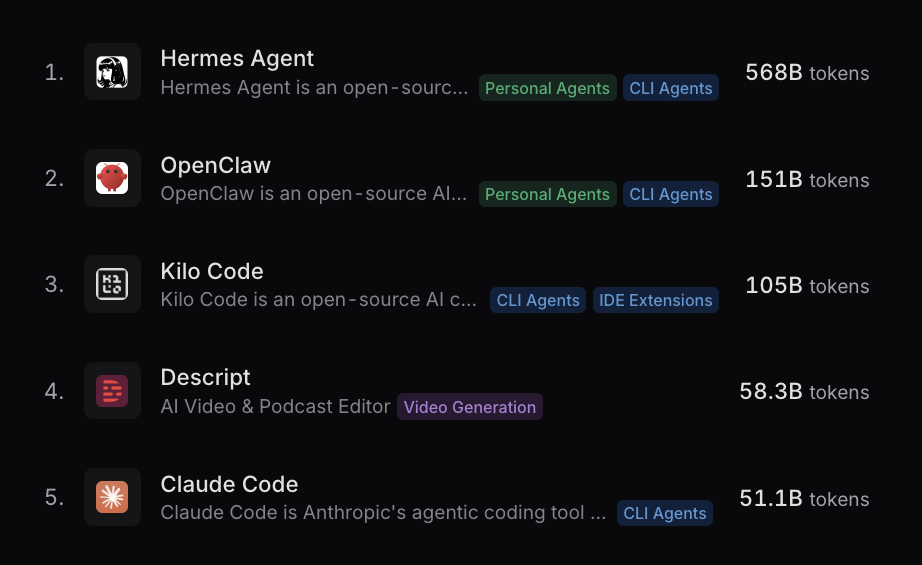
Some of the top AI apps in the world, like OpenClaw and Hermes Agent, are built on OpenRouter, and many use Claude Code and Codex plugged into OpenRouter as well. The entire ecosystem has embraced bringing the power of multiple models to the user, and so should you. This is just the beginning of the journey for OpenRouter. Keep an eye on them, because we think they’re going to be much more than just a “transfer switch”; it could be the entire power grid.

Deedy is a partner at Menlo Ventures focused on early-stage investments in AI/ML, next-generation infrastructure, and enterprise software. Having been an engineer and product leader at both a successful startup and large public companies, Deedy is well-equipped to help technical founders navigate how to build and scale enduring tech companies.…

Matt is a partner at Menlo Ventures and invests multi-stage across AI infrastructure and AI-native software. Since joining Menlo in 2015, Matt has led active investments in Anthropic, Lovable, Openrouter, Harness, Carta, Legora, Benchling, Grow Therapy, Semgrep, Skild, Armadin, Mimic, Netlify, True Anomaly, Envoy, Hover, Vivun, and Zylo. He formerly served on…